Divers FAQ's
eRDPml &
Nitrox eRDPml
Got Questions?
eRDPml & Nitrox RDP
Clear RDPml insights support transparent safety messaging that resonates with cautious divers and instructors alike. Highlighting this KPI in content signals commitment to compliance, training quality, planning, execution, and long-term customer trust.
eRDPml
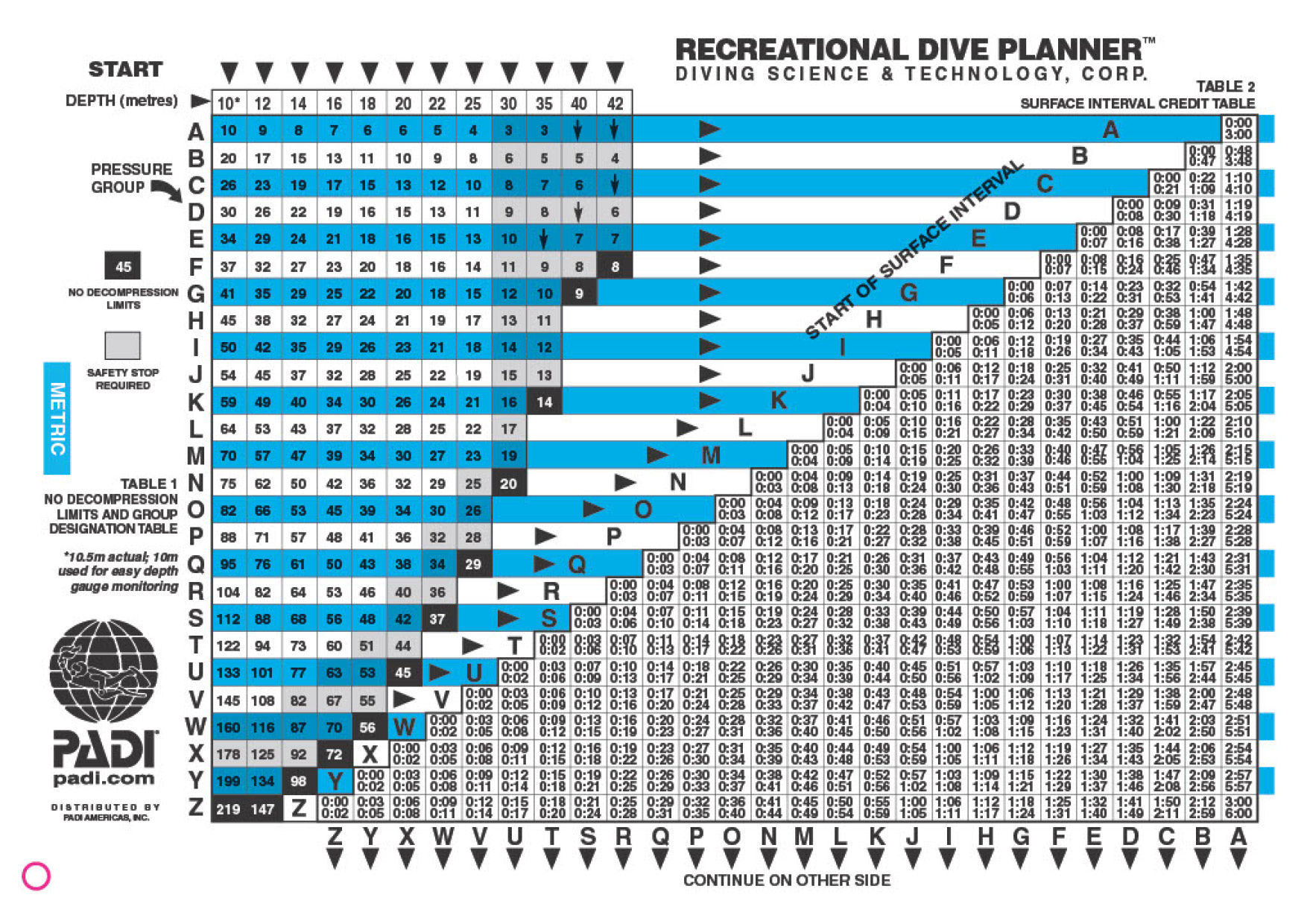
eRDPml (Recreational Dive Planner Multi Level) – The Recreational Dive Planner (RDP) is a decompression model and dive planning tool developed by PADI (and commonly used in many recreational diving programs) to help divers plan bottom time, depth, and required safety stops to stay within no-decompress or limited-decompression limits. It provides a structured way to estimate nitrogen loading and to determine safe ascent profiles.
Key components typically found in the RDP concept:
- Depth and bottom time grids: A set of tables or a calculator that maps maximum allowable bottom time at various depths to avoid decompression obligations.
- No-decompression limits (NDLs): The maximum time you can stay at a given depth without needing mandatory decompression stops during ascent.
- Decompression planning: If a dive exceeds NDL, the planner suggests decompression stops at specified depths and durations to safely off-gas inert gases.
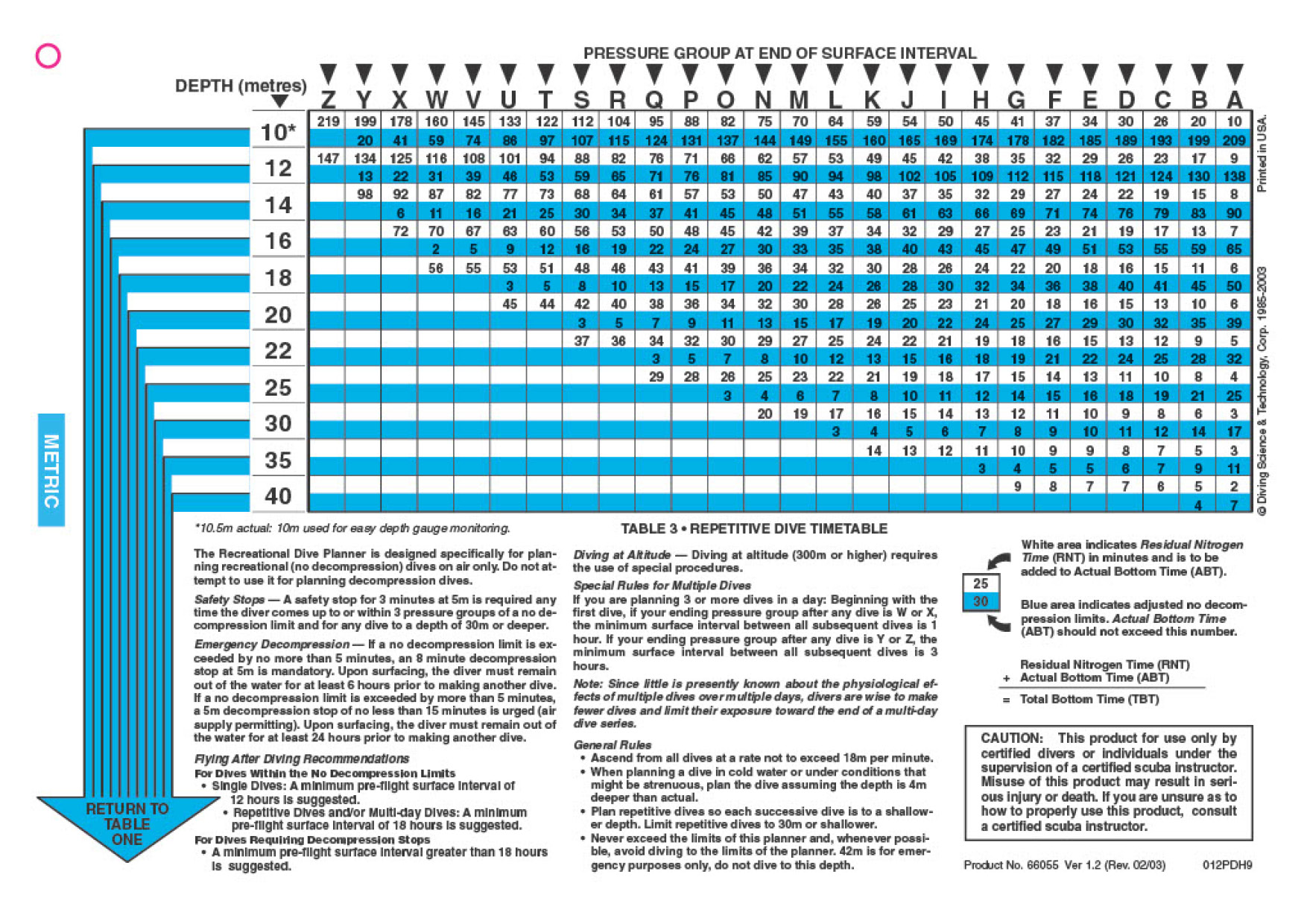
- Surface interval planning: Guidelines for how long you should wait before the next dive to off-gas nitrogen and reduce residual Nitrogen Time (RNT) on subsequent dives.
- Residual Nitrogen Time (RNT) or repetitive dive planning: Adjustments to NDLs based on previous dives within the same day or consecutive days.
- Gas loading considerations: Rules of thumb for how much gas to reserve for ascent, safety stops, and contingencies.
- Safety stops: Recommendation to pause at about 3–5 meters (10–15 feet) for a few minutes to off-gas nitrogen, even on no-decompression dives.
- Dive profile recording: A place to note depth, time, surface interval, and planned vs. actual dive data for post-dive review.
How it’s used in practice:
- Determine your planned depth and bottom time for a dive.
- Look up or compute the NDL for that depth.
- If your planned bottom time is within the NDL, plan a safe ascent with a safety stop.
- If your bottom time exceeds the NDL, plan a decompression dive with required stops at specified depths and durations.
- After surfacing, calculate the surface interval before the next dive to reduce residual nitrogen time.
Common formats:
- Table-based RDP (the classic five-column or four-column no-decompression tables), sometimes color-coded for quick reference.
- Electronic or mobile-app versions that implement the same logic but with input fields for depth and bottom time and automatic calculation of NDLs, decompression stop requirements, and surface intervals.
Important note:
- The RDP is designed for recreational diving up to about 40 meters (130 feet) and assumes standard breathing gas (air). Technical dives or gas mixtures require different models (e.g., Bühlmann, VPM, RGBM) and training.
- Always use current, regionally appropriate tables or approved digital tools, and follow your training agency’s procedures.
Designed for recreational dives up to ~40 meters (130 feet) on air; not for technical or mixed-gas dives.
eRDPml
Recreational Dive Planner
RDP emphasizes staying within (NDLs) or planning required decompression stops if limits are exceeded, plus surface interval planning. RNT adjustments account for repetitive dives, and optional safety stops help off-gas nitrogen.
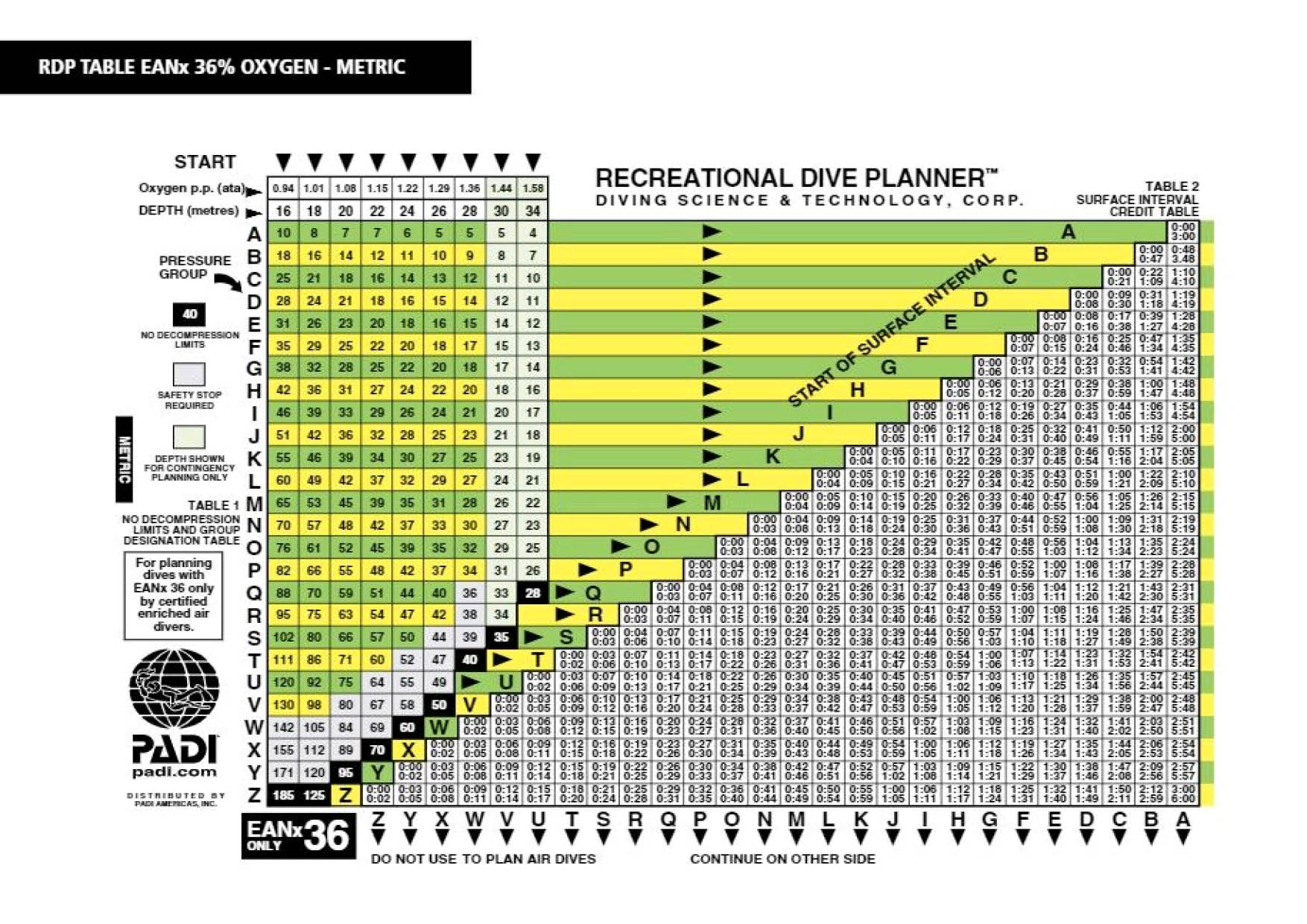
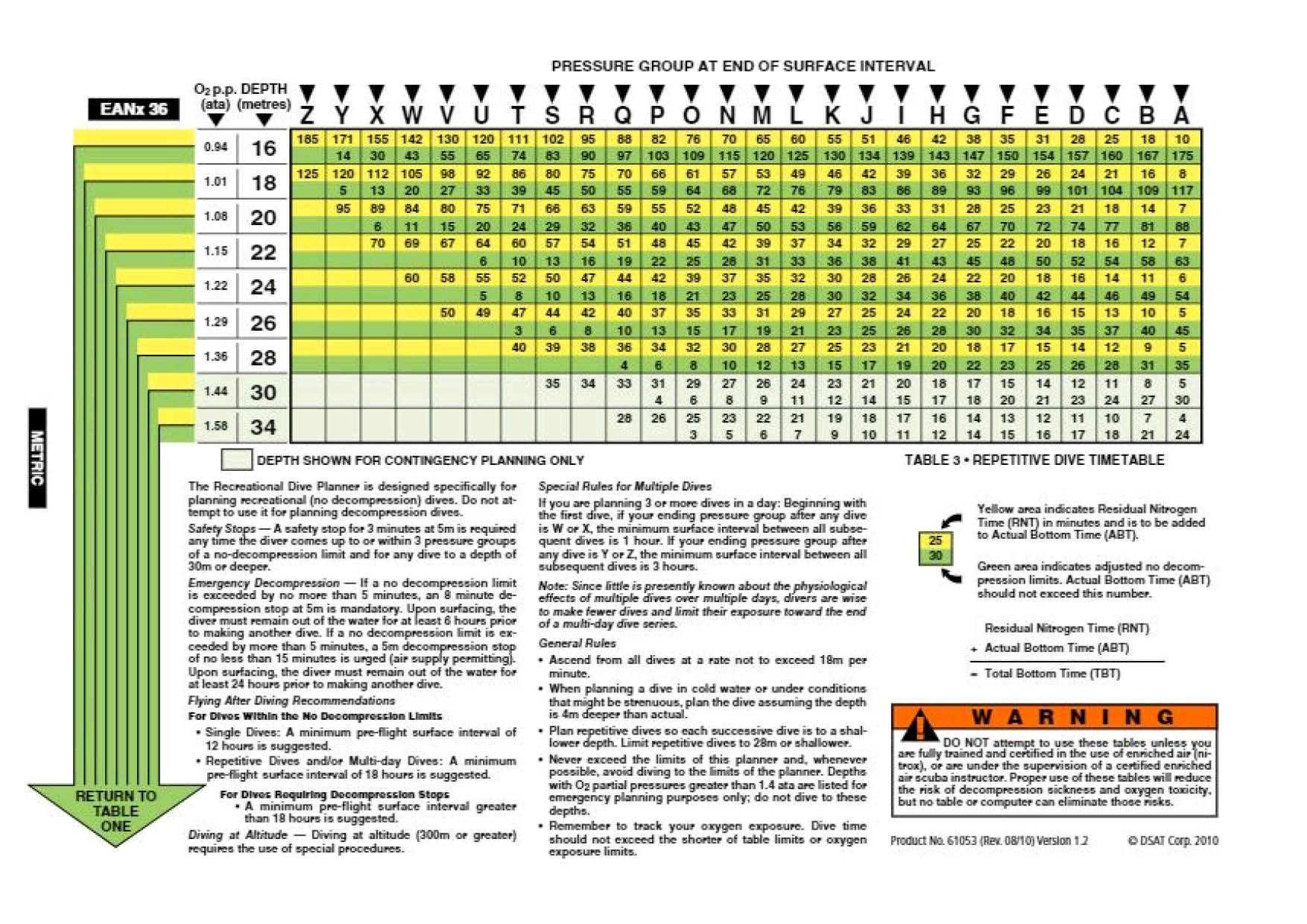
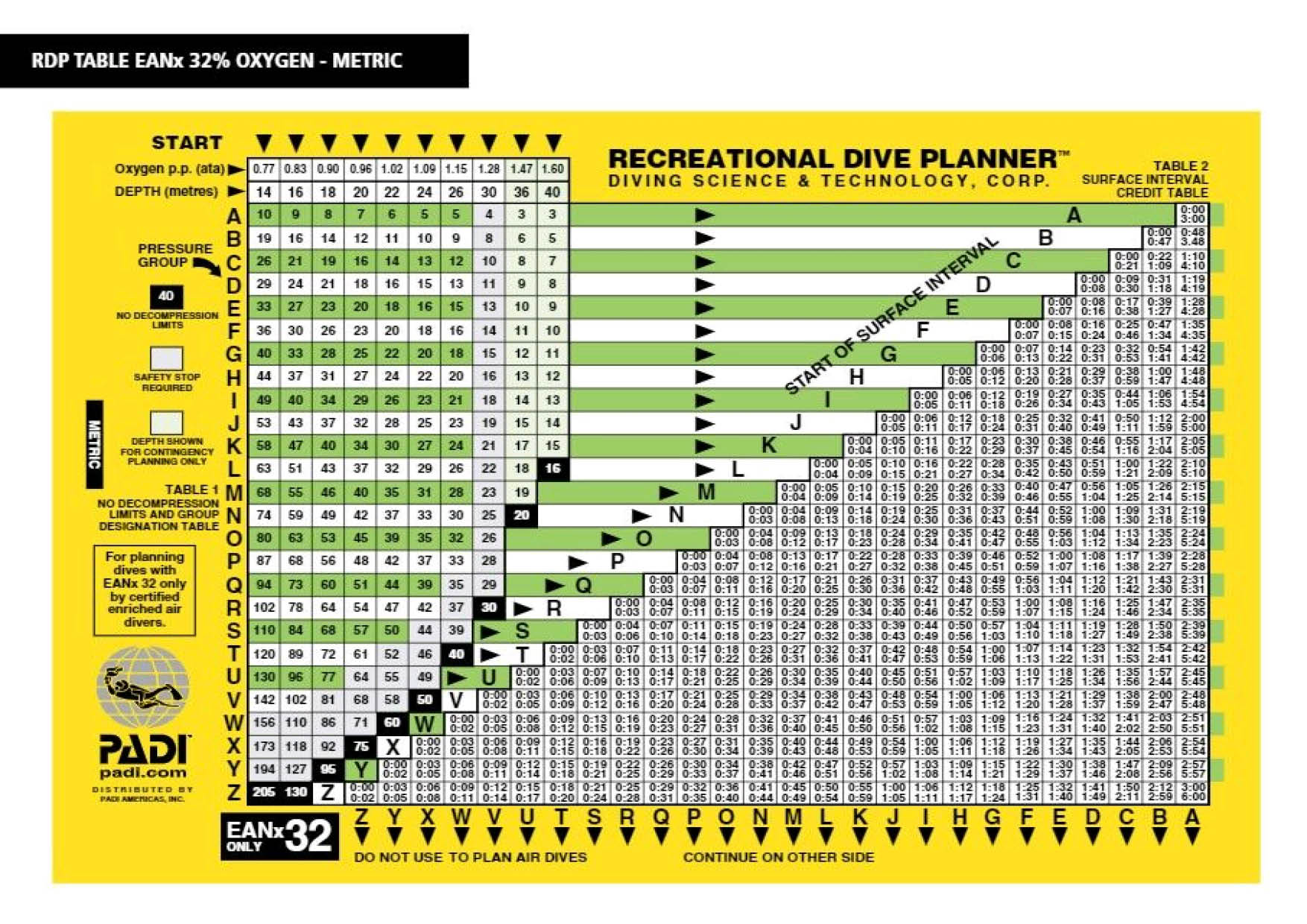
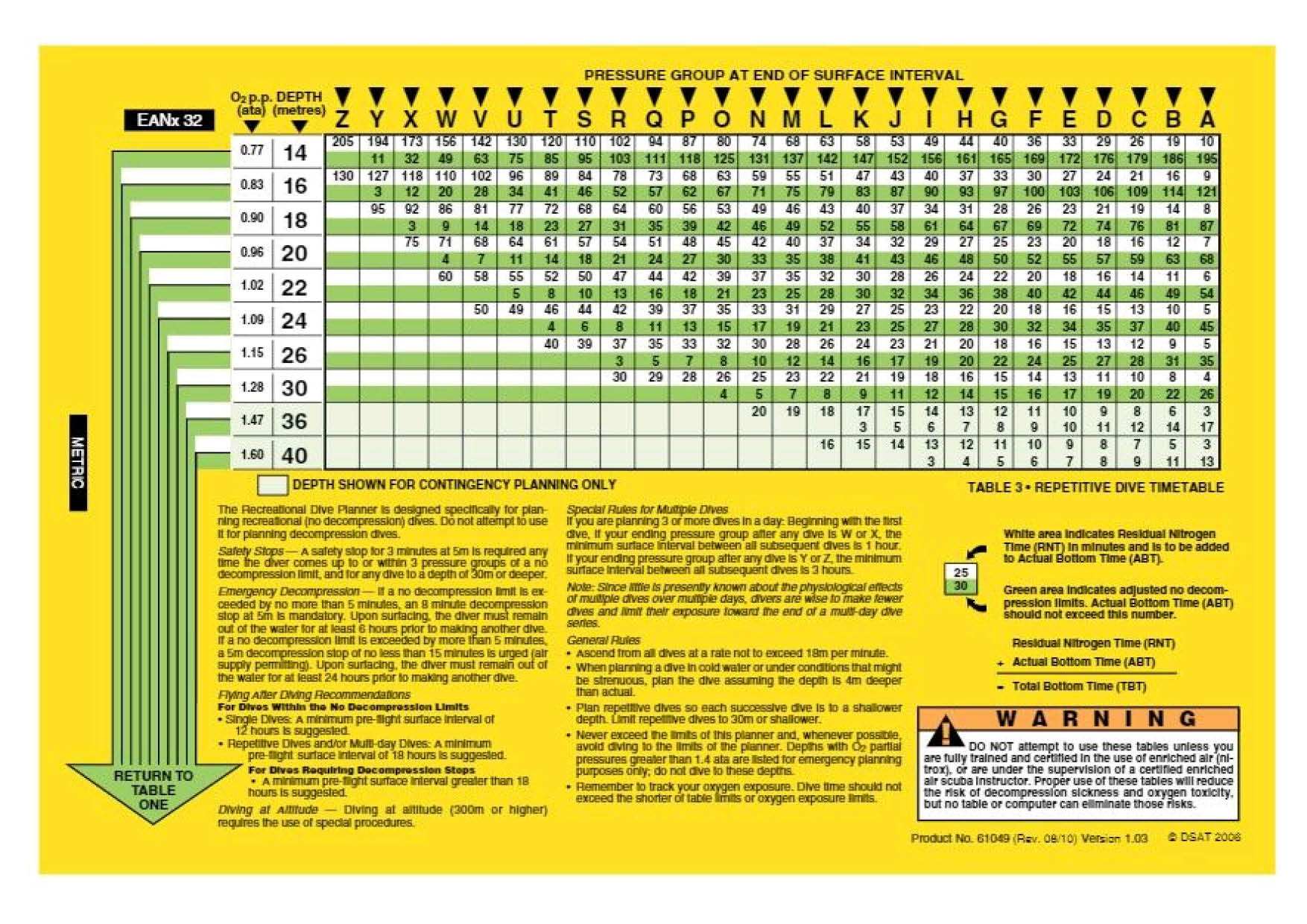
Nitrox eRDPml
Nitrox is a breathing gas used in scuba diving that contains a higher proportion of oxygen than atmospheric air. The most common mixes are EANx (enriched air nitrox) with oxygen fractions of 32% or 36%, though blends from about 21% to 40% oxygen are used in some dives.
By increasing the oxygen content and reducing the nitrogen portion, Nitrox can reduce nitrogen absorption in the tissues, which can extend no-decompression limits and shorten surface intervals on recreational dives. However, higher oxygen levels increase the risk of oxygen toxicity, especially at deeper depths, soNitrox is typically recommended for shallower recreational dives (often up to 30–40 meters, depending on the mix and training). Key concepts:
- EANx percentages: common are 32% and 36%.
- MOD (Maximum Operating Depth): deepest depth at which a given mix can be breathed safely to avoid oxygen toxicity.
- Benefits: longer bottom times, shorter surface intervals (in some scenarios), reduced nitrogen loading.
- Trade-offs: reduced bottom gas supply due to lower nitrogen, need for careful dive planning and training, and enhanced O2 toxicity awareness.
Nitrox eRDPml
Recreational Dive Planner
You typically need an appropriate Nitrox certification (often called Enriched Air Nitrox {EANx}) to dive with these mixtures, learning about depth limits, analyzing gas, and how to plan dives with Nitrox.
Got More Questions? We’ve got you Covered!
Frequently Asked Questions
Certification
- How long does it take to complete a course?
- Do I need to prepay for a course or fun dive?
- How much time do I need to dedicate to eLearning?
- Does my course expire?
- Do I need to know how to swim?
- Do I need medical clearance to dive?
- Can I Fly after diving?
- When do I need to take a refresher (ReActivate) session after a period of activity?
- What should I bring when I come diving?
- How long will it take for my certification to be processed?
- Can I scuba dive without certification?
- How deep can I go with my PADI certification or experience?
- Can I dive with a PADI certification anywhere in the world?
- Does PADI certification expire?
- Will I receive a plastic certification card?
- Continue Education
Explore More
- How long does it take to complete a course?
- Do I need to prepay for a course or fun dive?
- How much time do I need to dedicate to eLearning?
- Does my course expire?
- Do I need to know how to swim?
- Do I need medical clearance to dive?
- Can I Fly after diving?
- When do I need to take a refresher (ReActivate) session after a period of activity?
- What should I bring when I come diving?
- How long will it take for my certification to be processed?
- Can I scuba dive without certification?
- How deep can I go with my PADI certification or experience?
- Can I dive with a PADI certification anywhere in the world?
- Does PADI certification expire?
- Will I receive a plastic certification card?
- Continue Education
General Queries
- Operating Hours
- Contact Us
- Payment Method
- Servicing Diving Gear?
- Do You Sell diving gear?
- Cancellation Policy
- Why is Khorfakkan Famous?
- Which Ocean does khorfakkan look at?
- Is khorfakkan good for Scuba Diving?
- Things to pack for diving
Explore More
- Operating Hours
- Contact Us
- Payment Method
- Servicing Diving Gear?
- Do You Sell diving gear?
- Cancellation Policy
- Why is Khorfakkan Famous?
- Which Ocean does khorfakkan look at?
- Is khorfakkan good for Scuba Diving?
- Things to pack for diving
Nitrox eRDPml
- eRDP
- Nitrox eRDPml
Explore More
- eRDP
- Nitrox eRDPml
Think Like a Diver
- The Proper Dive Buddy Check – How Do You Say BWRAF?
- Rules Every Diver Should Follow
- Top 10 Scuba Diving Rules
- 10 Things You Should Never Do Immediately After Diving
- Most Important Scuba Diving Abbreviations & Acronyms
- Diving Signals
- Marine Life Hand Signals
- Dive Briefing
- Boat Diving Guidelines
Explore More
- The Proper Dive Buddy Check – How Do You Say BWRAF?
- Rules Every Diver Should Follow
- Top 10 Scuba Diving Rules
- 10 Things You Should Never Do Immediately After Diving
- Most Important Scuba Diving Abbreviations & Acronyms
- Diving Signals
- Marine Life Hand Signals
- Dive Briefing
- Boat Diving Guidelines
PADI Theory - Physics
- Physics
Explore More
- Physics
PADI Theory - Physiology
- Physiology
Explore More
- Physiology
PADI Theory - Equipment
- Cylinders
- Cylinder Valve
- More Equipment
Explore More
- Cylinders
- Cylinder Valve
- More Equipment
PADI Theory - Dive Skills
- Buoyancy – Proper Weighting Skills
Explore More
- Buoyancy – Proper Weighting Skills
PADI Theory - Environment
- 10 Tips to Save the Ocean
- What is Dive Against Debris?
Explore More
- 10 Tips to Save the Ocean
- What is Dive Against Debris?
Emergency First Response
- What is Emergency First Response (EFR) ?
- Who can take an Emergency First Response provider course?
- What is an AED and why would I want to learn about it?
- How often must I refresh my skills?
- What the Emergency First Response Course Covers?
Explore More
- What is Emergency First Response (EFR) ?
- Who can take an Emergency First Response provider course?
- What is an AED and why would I want to learn about it?
- How often must I refresh my skills?
- What the Emergency First Response Course Covers?
Rescue
- What Is the PADI Rescue Diver Course?
- What Does a Rescue Diver Actually Do?
- How Hard Is It To Become a Rescue Diver?
- What Prerequisites Do I Need To Take Part in a PADI Rescue Diver Course?
- How Many Dives Does It Take To Become a Rescue Diver?
- What Skills Do You Learn During the Rescue Diver Course?
- Why Do I Need First Aid Training To Do the Rescue Diver Course?
- Do I Really Need To Become a Rescue Diver? Is It Worth Taking the Course?
Explore More
- What Is the PADI Rescue Diver Course?
- What Does a Rescue Diver Actually Do?
- How Hard Is It To Become a Rescue Diver?
- What Prerequisites Do I Need To Take Part in a PADI Rescue Diver Course?
- How Many Dives Does It Take To Become a Rescue Diver?
- What Skills Do You Learn During the Rescue Diver Course?
- Why Do I Need First Aid Training To Do the Rescue Diver Course?
- Do I Really Need To Become a Rescue Diver? Is It Worth Taking the Course?
DAN Insurance
- Long term Dan Insurance Plan
- Short Term Dan Insurance Plan
Explore More
- Long term Dan Insurance Plan
- Short Term Dan Insurance Plan