Divers FAQ's
PADI Theory - Dive Skills
Enhancing Your
Dive Skills?
Dive Skills
Perfecting buoyancy control is one of the most important skills a scuba diver can develop. Proper weighting, controlled breathing, small BCD adjustments, balanced trim and efficient fin movement help you hover comfortably, reduce unnecessary air consumption, extend bottom time and move through the water with greater control. Good buoyancy also helps protect coral reefs and marine life by reducing accidental contact with the seafloor. In this guide, you will learn the principles behind buoyancy, how saltwater and freshwater affect weighting, and how to use practical pre-dive checks to improve your position, comfort and confidence underwater.
Buoyancy is the upward force exerted by water on an object placed in it. According to Archimedes’ principle, this force is equal to the weight of the water displaced by the object. A diver’s buoyancy depends on several factors, including body composition, exposure protection, scuba equipment, air remaining in the cylinder, breathing technique and the density of the water. The goal of proper weighting is not to add as much lead as possible, but to use only the amount required to remain comfortably neutral at the end of the dive when the cylinder is close to empty and the exposure suit has been compressed at depth.
Freshwater and saltwater do not provide the same amount of lift. Saltwater is denser than freshwater, so a diver generally needs more weight to achieve the same level of buoyancy in the ocean. As a general reference, one litre of freshwater weighs approximately one kilogram, while one litre of seawater weighs slightly more. The exact weight difference depends on the water’s salinity, your exposure protection and your equipment configuration. Always complete a controlled buoyancy check before entering the water rather than relying only on a fixed percentage or a previous dive setup.
A proper weighting check should be completed in the water with the equipment and exposure protection you will use for the dive. With a nearly empty cylinder, a normally inflated BCD and a relaxed breathing pattern, you should be able to float at eye level while holding a normal breath. When you exhale slowly, you should begin to descend without forcing yourself down. If you cannot descend while relaxed, you may need a small amount of additional weight. If you sink quickly, require excessive BCD air or struggle to remain comfortably at the surface, you may be carrying too much weight. Make adjustments in small increments and record the final configuration for future dives.
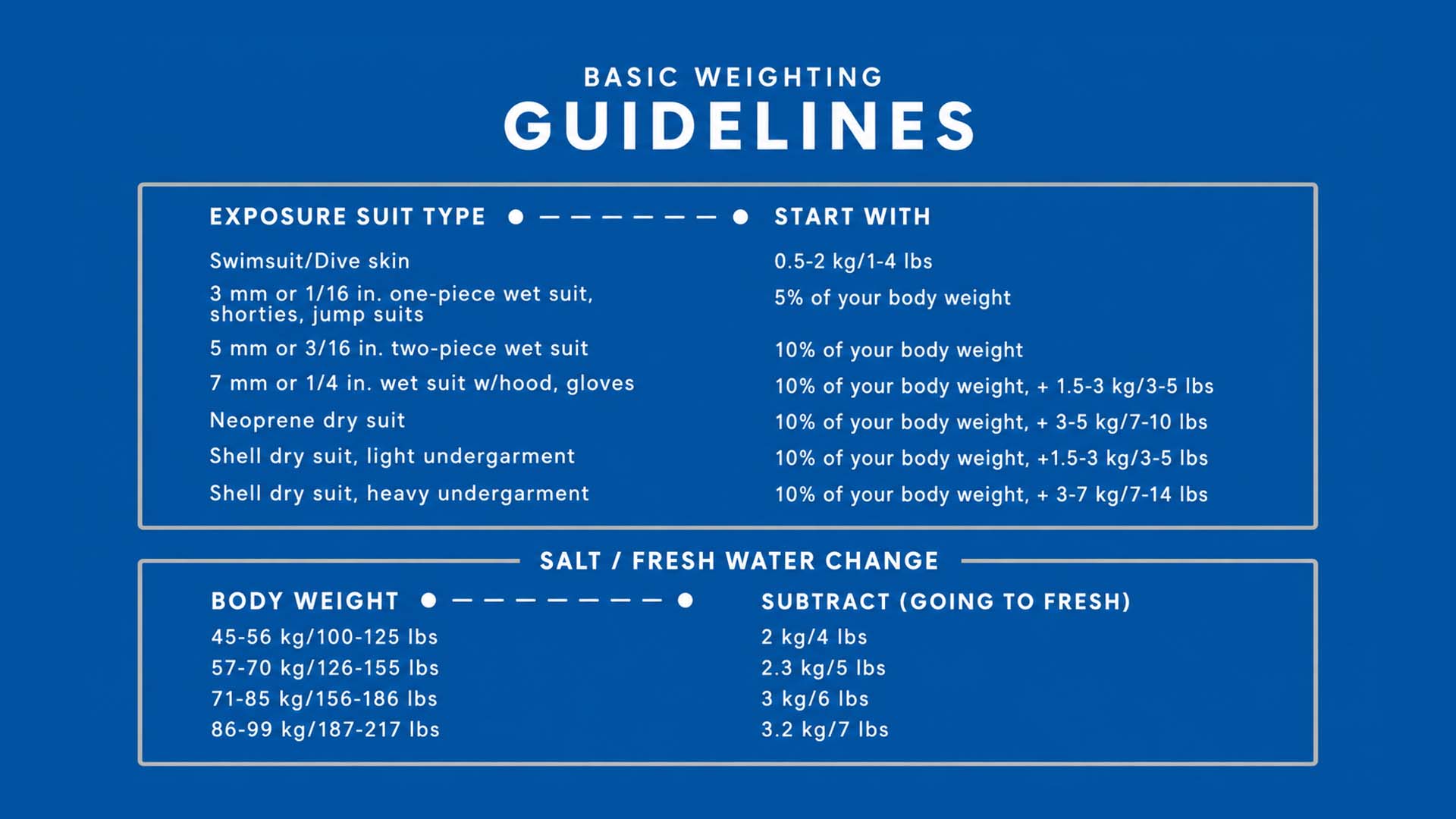
When moving from saltwater to freshwater, many divers need to remove some weight because freshwater provides less buoyant lift than seawater. The amount to remove varies according to body weight, exposure suit thickness, cylinder type, equipment and personal buoyancy. The figures shown in a weighting guideline should be treated only as starting points, not as universal rules. A proper in-water buoyancy check is more reliable than estimating weight from body weight alone.
The force of buoyancy is predicted by Archimedes’ Principle, which says:
An object wholly or partly immersed in a fluid is buoyed up by a force equal to the weight of the fluid displaced by the object.
This means that the amount of buoyancy – upward force – is based on how much fluid the object displaced and the weight of the fluid displaced.
Weight of Water
Fresh Water: 1 litre weighs 1 kilogram/1 cubic foot weighs 62.4 pounds
Saltwater: 1 litre weighs 1.03 kilograms/1 cubic foot weighs 64 pounds
The denser the fluid the more upward force (buoyancy) you get for a given volume of displacement. Saltwater is denser and weighs more than fresh water because of its dissolved salts.
The difference between fresh and salt water may not look like much, but it’s enough that you need more weight when diving in the ocean than in a lake, assuming you’re using the same exposure suit and other gear.
What is buoyancy control in scuba diving?
Buoyancy control is the ability to maintain your desired position in the water by managing your breathing, weighting, BCD inflation and body position. Effective buoyancy control allows you to hover, ascend and descend gradually, conserve energy and reduce accidental contact with the seafloor.
How much weight should I use for scuba diving?
The correct amount of weight depends on your body, exposure protection, equipment, cylinder type and whether you are diving in freshwater or saltwater. Complete a buoyancy check in the water with your actual dive equipment. Avoid using a fixed percentage of body weight as a substitute for an in-water assessment.
Do I need more weight in saltwater or freshwater?
Most divers need more weight in saltwater because seawater is denser and provides more buoyant lift than freshwater. The exact difference varies by equipment and exposure protection, so you should confirm your weighting with a buoyancy check.
How does buoyancy control improve air consumption?
Good buoyancy reduces unnecessary finning, physical effort and repeated BCD adjustments. By moving efficiently and maintaining a stable position in the water, divers may reduce exertion and improve air consumption. Air consumption also depends on depth, breathing, workload, equipment and individual physiology.
What is proper trim in scuba diving?
Proper trim is a balanced body position in the water, usually with the diver close to horizontal. Good trim reduces drag, improves fin efficiency and helps prevent fins or equipment from disturbing the bottom.
Can better buoyancy protect coral reefs?
Yes. Maintaining neutral buoyancy, horizontal trim and controlled fin movements can reduce accidental contact with coral, rocks and other marine life. Divers should also maintain appropriate distance from the seafloor and avoid touching or holding marine organisms.
More Questions? We’ve got you Covered!
Frequently Asked Questions
Certification
- How long does it take to complete a course?
- Do I need to prepay for a course or fun dive?
- How much time do I need to dedicate to eLearning?
- Does my course expire?
- Do I need to know how to swim?
- Do I need medical clearance to dive?
- Can I Fly after diving?
- When do I need to take a refresher (ReActivate) session after a period of activity?
- What should I bring when I come diving?
- How long will it take for my certification to be processed?
- Can I scuba dive without certification?
- How deep can I go with my PADI certification or experience?
- Can I dive with a PADI certification anywhere in the world?
- Does PADI certification expire?
- Will I receive a plastic certification card?
- Continue Education
Explore More
- How long does it take to complete a course?
- Do I need to prepay for a course or fun dive?
- How much time do I need to dedicate to eLearning?
- Does my course expire?
- Do I need to know how to swim?
- Do I need medical clearance to dive?
- Can I Fly after diving?
- When do I need to take a refresher (ReActivate) session after a period of activity?
- What should I bring when I come diving?
- How long will it take for my certification to be processed?
- Can I scuba dive without certification?
- How deep can I go with my PADI certification or experience?
- Can I dive with a PADI certification anywhere in the world?
- Does PADI certification expire?
- Will I receive a plastic certification card?
- Continue Education
General Queries
- Operating Hours
- Contact Us
- Payment Method
- Servicing Diving Gear?
- Do You Sell diving gear?
- Cancellation Policy
- Why is Khorfakkan Famous?
- Which Ocean does khorfakkan look at?
- Is khorfakkan good for Scuba Diving?
- Things to pack for diving
Explore More
- Operating Hours
- Contact Us
- Payment Method
- Servicing Diving Gear?
- Do You Sell diving gear?
- Cancellation Policy
- Why is Khorfakkan Famous?
- Which Ocean does khorfakkan look at?
- Is khorfakkan good for Scuba Diving?
- Things to pack for diving
Nitrox eRDPml
- eRDP
- Nitrox eRDPml
Explore More
- eRDP
- Nitrox eRDPml
Think Like a Diver
- The Proper Dive Buddy Check – How Do You Say BWRAF?
- Rules Every Diver Should Follow
- Top 10 Scuba Diving Rules
- 10 Things You Should Never Do Immediately After Diving
- Most Important Scuba Diving Abbreviations & Acronyms
- Diving Signals
- Marine Life Hand Signals
- Dive Briefing
- Boat Diving Guidelines
Explore More
- The Proper Dive Buddy Check – How Do You Say BWRAF?
- Rules Every Diver Should Follow
- Top 10 Scuba Diving Rules
- 10 Things You Should Never Do Immediately After Diving
- Most Important Scuba Diving Abbreviations & Acronyms
- Diving Signals
- Marine Life Hand Signals
- Dive Briefing
- Boat Diving Guidelines
PADI Theory - Physics
- Physics
Explore More
- Physics
PADI Theory - Physiology
- Physiology
Explore More
- Physiology
PADI Theory - Equipment
- Cylinders
- Cylinder Valve
- More Equipment
Explore More
- Cylinders
- Cylinder Valve
- More Equipment
PADI Theory - Dive Skills
- Buoyancy – Proper Weighting Skills
Explore More
- Buoyancy – Proper Weighting Skills
PADI Theory - Environment
- 10 Tips to Save the Ocean
- What is Dive Against Debris?
Explore More
- 10 Tips to Save the Ocean
- What is Dive Against Debris?
Emergency First Response
- What is Emergency First Response (EFR) ?
- Who can take an Emergency First Response provider course?
- What is an AED and why would I want to learn about it?
- How often must I refresh my skills?
- What the Emergency First Response Course Covers?
Explore More
- What is Emergency First Response (EFR) ?
- Who can take an Emergency First Response provider course?
- What is an AED and why would I want to learn about it?
- How often must I refresh my skills?
- What the Emergency First Response Course Covers?
Rescue
- What Is the PADI Rescue Diver Course?
- What Does a Rescue Diver Actually Do?
- How Hard Is It To Become a Rescue Diver?
- What Prerequisites Do I Need To Take Part in a PADI Rescue Diver Course?
- How Many Dives Does It Take To Become a Rescue Diver?
- What Skills Do You Learn During the Rescue Diver Course?
- Why Do I Need First Aid Training To Do the Rescue Diver Course?
- Do I Really Need To Become a Rescue Diver? Is It Worth Taking the Course?
Explore More
- What Is the PADI Rescue Diver Course?
- What Does a Rescue Diver Actually Do?
- How Hard Is It To Become a Rescue Diver?
- What Prerequisites Do I Need To Take Part in a PADI Rescue Diver Course?
- How Many Dives Does It Take To Become a Rescue Diver?
- What Skills Do You Learn During the Rescue Diver Course?
- Why Do I Need First Aid Training To Do the Rescue Diver Course?
- Do I Really Need To Become a Rescue Diver? Is It Worth Taking the Course?
DAN Insurance
- Long term Dan Insurance Plan
- Short Term Dan Insurance Plan
Explore More
- Long term Dan Insurance Plan
- Short Term Dan Insurance Plan