Divers FAQ's
Think Like a Diver
How to
Think Like a Diver
Think Like a Diver
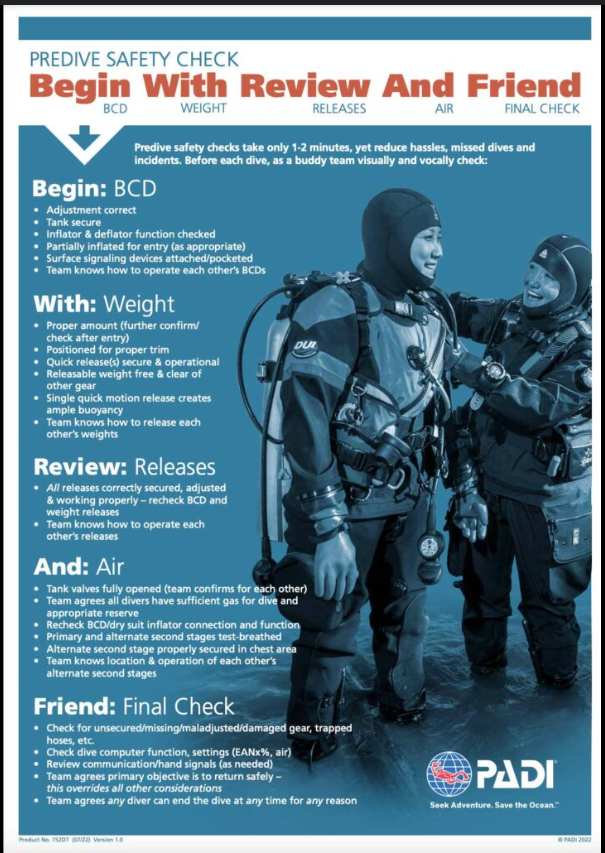
The buddy check, which has been given the acronym BWRAF, is an important accident prevention procedure new divers learn during the PADI Open Water Diver course. As divers gain more experience, the buddy check is often reduced to one diver asking the other, “You good?” Yet, a simple “you good” is not enough when it comes to adventure sports. It’s a sad fact that diver error is a leading cause of scuba diving accidents.
According to DAN, accidents are just as likely to happen to new divers compared to those certified for several years. Let’s build habits and remind each other that it is much easier to fix a small problem above water than to deal with a big problem underwater.
But how do you remember the proper buddy check procedure? Most new divers learn a mnemonic device to remember BWRAF, such as “Begin with Review and Friend”, to remember the steps in a buddy check (BWRAF). There are many other ways to remember the acronym, but we’ll get to those in a moment. First, here’s a quick review of how to do a proper buddy check.
When to Conduct a Buddy Check?
Before every dive. It’s important to note that if you are making more than one dive in a day, it’s not enough to simply make a buddy check before the first dive. After each surface interval, and before you enter the water for your next dive, you will need to make a thorough buddy check.
BWRAF
Below, we’ll detail what each letter of BWRAF stands for and how to perform that section of the buddy check. The steps should be completed in the following order:
B – BCD/Buoyancy
Make sure everything is connected and functioning. Test the inflator button and all the deflate valves (including the overpressure release valve). Dry suit divers should check that they have attached their dry suit inflator hose securely to the valve, check that it is working properly and then check to ensure their deflator valves vent air properly.
It’s important to know how to adjust your buddy’s gear. If you’re unfamiliar with their equipment, ask questions. In an emergency, you’ll be glad you did.
W – Weights
Ensure both you and your buddy have weights and that all weights are secure. If a BCD has integrated weight pockets, give a gentle tug on BCD weight pouches to confirm they’re locked in and won’t fall out during entry. Then, if applicable: check weight belts, rear BCD weight pockets, and any other places where weights may need adjustments. If your buddy is wearing a weight belt, ensure that it is set up for a quick release.
R – Releases
First, check all your releases and fastenings to confirm they are secure. Then, tell your diving partner how to open the releases if needed in an emergency. Do the same checks on your dive buddy. The most common releases are – tank straps, shoulder and chest straps, and belly straps. (Check to make sure there aren’t any hoses or other items positioned in a way that might prevent a diver from getting out of their equipment in an emergency.)
A – Air
Don’t skip this step! Taking a quick breath or two off the regulator isn’t enough. A proper air check means verifying the cylinder valve is completely open by This ensures the tank valve is open, the air is available for the dive, your monitoring gauge is working, and the air tastes and smells okay. Also, recheck the BCD and dry suit inflator connection and function, and check that the alternate second stage (regulator) is properly secured in the chest area, making sure your buddy knows where to locate it in an emergency.
Note: If you or your buddy are diving with nitrox, you should have analyzed your tanks prior to kitting up.
F – Final Check / Final Okay
As part of the final check, gather your remaining items of gear (mask, snorkel, fins, dive light, dive knife, camera, audible and visual signaling device, etc.). Be sure to secure loose hoses and other objects that may dangle and damage the reef. Lastly, do a head-to-toe check to ensure both you and your buddy are ready to go.
The steps described above are a generic, quick review for divers using an open circuit system. If you’re diving technical or rebreather, you should conduct safety checks appropriate to that diving procedure.
Babies With Rashes Are Fussy
Barf Will Really Attract Fish
Barry White Records Are Funky
Beans With Rice And Fish
Breathing Water Really Ain’t Fun
Bruce Willis Ruins/Rules All Films
Big Whales Really Are Fast
Burgers With Relish And Fries
Big White Rabbits Are Fluffy
Being Wary Reduces All Failures
Because We Really Are Friends
Because We Really Ain’t Fish
The Value Of BWRAF
As divers, safety is our number one priority. Safety first for ourselves, then for other divers, and even the safety of marine life and coral reefs. Because we can all make mistakes, following BWRAF as a buddy check can prevent equipment problems and human errors. According to DAN’s 10 Ways to Prevent Scuba Diving Accidents, five out of 10 scuba accidents likely could have been prevented by a pre-dive buddy check. Checking your equipment and your buddy’s is vital to safety underwater, so don’t forget to do a buddy check before each and every dive!
Common Mistakes Divers Make with BWRAF
Rushing through the safety check – We get it, you’re excited to jump into the water! However, to ensure a fun and safe dive, it’s crucial for all divers to properly execute the full pre-dive safety check. This means taking a few minutes to properly follow every step of the BWRAF check.
Ignoring minor equipment issues – A lightly cracked dive computer or a broken mask seal may seem like no biggie on the surface. But once you begin your descent, these minor equipment issues can cause serious discomfort and potentially fatal equipment malfunctions. If you notice anything less-than-perfect during the BWRAF check, make sure to remedy it before beginning your dive.
Not communicating with their buddy – Some divers may be nervous when diving with a new buddy. but the BWRAF check is an excellent way to connect over trusting your buddy to check your equipment setup. Divers should encourage each other to vocalise what they observe during each step. Such as “I can see your weights are nice and secure, let me give them a gentle tug to make sure they won’t come loose”.
Not checking airflow thoroughly – As we covered earlier, taking a few breaths out of the regulator is not enough to adequately check airflow in the equipment. During the buddy check, you must follow all the steps, including breathing from the primary and alternate second stages while looking at an SPG or air-integrated computer. additionally, checking the inflator hose, and the alternate inflator hose.
There’s one important rule we haven’t talked about: respect for marine life and the environment. Some phrase it as, “Take only pictures, leave only bubbles.” Others may say, “Do no harm, leave no trace.” Regardless of how you put it, every diver must remember they are merely visitors to the underwater world and show the utmost respect.
There are also a few safety rules every diver should follow. These aren’t PADI certification rules (although you will learn to do them in PADI courses); they are general dive safety rules based on years of research:
Do a buddy check before every dive
Always make a 3-minute (minimum) safety stop
Don’t exceed a safe ascent rate
Follow DAN’s guidelines about flying after diving
If you don’t remember what BWRAF stands for, the depth for a safety stop or what a safe ascent rate is, it might be time for a scuba refresher.
Diving has a great safety record when you dive responsibly, following the rules and regulations. That’s the whole reason they exist, after all — to keep you healthy and whole and ready to dive again the second you finish your surface interval. Whether you’re still learning to dive or have a lot of experience, implementing these ten safety precautions will reduce your risk when you’re underwater.
1. Make a Safety Stop
When is a safety stop required? Divers should make a safety stop at the end of every dive at a depth of 15 feet for three to five minutes. Safety stop diving gives your body extra time to release excess nitrogen that builds up in your system during the dive. Deep technical dives commonly require deeper and longer decompression stops, but three to five minutes at 15 feet is standard for recreational dives within no stop dive limits.
2. Control Your Ascent Rate
You don’t want to rocket toward the surface for a few reasons. First, your body needs time to release dissolved nitrogen (hence your safety stop). Second, since air expands while rising through the water column rapidly, air expanding in your lungs as you ascend too quickly increases the risk of lung overexpansion injuries like air embolism. And, to control your ascent rate, control your ascent rate. That is, as air in your BCD, dry suit or wetsuit material expands, you become more buoyant and your ascent rate starts to accelerate. When you’re ascending slowly, you can easily release air from your BCD/dry suit to keep your buoyancy and ascent rate under control. But if you ascend rapidly, it’s harder to compensate fast enough, leading to a “snowball” effect of more increasing buoyancy and ascent speed. Learning how to ascend when scuba diving is one of the most important diving rules.
Want to be a safer diver? Become a Rescue Diver through PADI.
3. Keep Breathing
Continually breathing when submerged protects your lungs from lung overexpansion injuries. This is not important just during ascent, but throughout the entire dive. Not only does this reduce your risk in case you’re ascending and don’t realize it for some reason (rare, but it happens), but you’re developing and maintaining the right habit.
4. Watch Your Gauges
Your gauges, or dive computer, constantly tell you important information like how deep you are, how long you’ve been down, how much air and no stop time you have left, which way is north and so on. Check these frequently to ensure you’re staying within your dive plan. Your air consumption especially can change not only from day-to-day, but within the dive depending depth, current, exertion, stress, body temperature and a host of other variables. Don’t assume a certain fill will give you the same bottom time as a previous dive. Check your air levels often – every few minutes at the most – and turn the dive so you surface with at least 500 psi reserve.
5. Stick with Your Buddy Diving is not a solo sport. “Buddy diving is a potentially life-saving practice for scuba divers,” according to DAN’s 2019 report on dive fatalities. “Properly implemented, it helps to prevent accidents and to avert bad outcomes of possible incidents. Buddy diving starts with sharing the dive plan, getting familiar with each other’s equipment, pre-dive buddy check, keeping an eye on each other during the dive, sticking to the plan, returning to the surface together, and conducting a post-dive debrief.” Statistics and research repeatedly support that the buddy system reduces risk.
6. Dive Within Your Training
With the exception of being under instruction with a professional instructor, never attempt a dive beyond your training, whether that’s visiting a wreck deeper than you’re certified to go or entering a cave system without taking a rigorous cave diving class. Training is vital to knowing how to handle different underwater environments. You can always take classes to advance your dive repertoire by learning the skills you need to penetrate a wreck, dive deep, explore a cave or dive high in the mountains, but don’t try to learn them by yourself.
7. Dive Within Your Limits
Diving within your limits differs from diving within your training — personal limits change from day to day and year to year. You may be qualified to dive to 100 feet, but if you haven’t been diving in a few years, jumping straight into a dive that deep likely isn’t the best plan. Or, if not quite in your usual fitness due to not exercising for a few weeks, a rough shore dive with your local club may be off the table until you’re back to yourself. You can always make it a goal to work up to your old limits, but, as life changes, respect your evolving boundaries.
8. Ensure You Equalize
Understanding how fast you can descend when scuba diving is crucial. Do not keep descending if your ears hurt. Diving isn’t supposed to hurt, and doing so can cause serious and lasting damage, such as a ruptured drum or worse, which can permanently impair your hearing and exclude you from ever diving again. If you are struggling to equalize, signal your buddies (they can’t know your ears hurt unless you tell them) rise slightly to a shallower depth and try again. If the pain continues, call the dive. Never, ever “force it.”
9. Do a Pre-Dive Safety Check
Looking over your gear and buddy’s gear (and having them do the same) is a good way to catch small issues that can become a big deal underwater. Look for open valves, full cylinders and properly secured releases, as well as things like loose weights that could fall and trigger a rapid ascent. Test breathe second stages and test inflators/deflators to be sure they’re working properly. This process also acquaints you with your buddy’s gear in the event there is an emergency in which you need to assist.
10. Remember Your Objective
The primary objective of every dive is for everyone to come back safely. Do not let secondary objectives, like photographing a certain species or seeing a specific part of a wreck, get in the way of remembering your primary objective. Even if you “only need a minute” to get that “perfect shot” but you’re at your turn pressure, skip the shot and turn the dive knowing you’re fulfilling the dive’s main objective.
1. Flying After Diving
Flying after scuba diving is one of the more widely known risks to divers. This issue comes up frequently in the diving world, because divers want to take full advantage of their vacations and also get the most diving time in while they can.
The main reason divers should avoid flying immediately after diving is the pressure inside the airplane’s cabin. The air pressure inside the cabin lessens as you reach altitude. When you’re flying in a plane right after diving, the increase in altitude results in a drop in pressure which is similar to a fast ascent while diving.
The longer and deeper you dive, the more nitrogen is absorbed into your blood and tissues. Upon returning to the surface, the ambient pressure reduces, and the nitrogen reverts to gas bubbles, which can be very dangerous when inside the body.
Decompression needs to be done slowly, so the nitrogen can safely pass back out through your lungs. If you ascend too quickly, the nitrogen can form bubbles in your blood or tissues, which can be painful and possibly fatal. The resulting condition is known as decompression sickness (or ‘the bends’).
Waiting the correct amount of time before flying will reduce the nitrogen in your body. As a general recommendation, leave a 24-hour surface interval before flying after doing any type of diving. This rule covers all types of dives and adds extra time as a safeguard for peace of mind.
Flying After Diving Guidelines from Divers Alert Network (DAN)
The following DAN guidelines apply to air dives followed by flights at cabin altitudes of 2,000 to 8,000 feet (610 to 2,438 meters) for divers who do not have symptoms of decompression sickness (DCS):
For a single no-decompression dive, wait at least 12 hours before flying
For multiple dives per day or multiple days of diving, wait at least 18 hours before flying
For dives requiring decompression stops, wait at least 24 hours before flying
In addition, you should wait longer if directed by the no-fly time indicated on your dive computer. To err on the side of safety, many divers plan a 24-hour surface interval before flying after any type of diving and spend this time resting or exploring topside attractions. However, keep reading to be aware of some other activities you should avoid doing straight after scuba diving.
2. Mountain Climbing or Driving
It may surprise you to discover that driving or hiking to the top of a 10,000-foot (3,048-meter) mountain puts you at the same risk for decompression sickness (DCS) as flying in an airplane. Cabin pressure in an average commercial jet is equivalent to being at 6,000 to 8,000 feet (1,800 to 2,400 meters) above sea level. If simulated altitude puts you at risk for DCS, being at altitude is also high risk. That said, people do dive at altitude and there are special dive tables to follow. This type of diving is called altitude diving.
You should avoid mountain climbing in the first 24 hours after a dive. If you are planning to combine mountain climbing and scuba diving on the same trip, go mountain climbing first to minimize any potential decompression sickness risk. It is better to go climbing before a dive, and this is an easy solution to reduce risk from a DCS perspective. Just be mindful of other factors that could affect your fitness to dive, such as exertion and fatigue so be sure to rest and hydrate after your climb or hike and before you go diving.
In the same way, if your journey home involves driving to altitude after diving, you should allow a sufficient surface interval to reduce the risk of decompression sickness (ideally 24 hours)—or choose an alternative route.
3. Ziplining After Diving
Ziplining as an activity is fine. Again, the concern is going to altitude after diving. It is recommended to confirm the altitude of your ziplining destination before you book.
Ziplining usually occurs on a mountain or elevated area and should be avoided for 24 hours after a dive due to the altitude. This helps reduce the risk of decompression sickness (DCS) and enjoy your ziplining worry-free.
Other High-Altitude Activities to Avoid for 24+ Hours After Diving
Parachute jumping or skydiving
Paragliding
Parasailing
Skiing or snowboarding
Air ballooning
We always recommend reaching out to an individual who has more information about the destination and its altitude. The best thing to do is contact a local PADI Dive Shop and ask them about other activities that you can do safely after diving—such as local food, relaxation, or events.
4. Deep Tissue Massage
What? No massage? Relax and breathe. Here’s the good news – according to the Divers Alert Network (DAN): “Massage has not been confidently associated with…cases of DCS”. Experts caution against deep tissue massage, but a gentle relaxation massage is probably fine. The two main concerns with deep tissue massage are:
Increased blood flow might lead to bubble formation
Muscle soreness which can lead to misdiagnosis (or delayed diagnosis) of decompression sickness (DCS)
The advice is to stay away from deep tissue massages for at least 12 hours after scuba diving.
5. Relaxing in a Hot Tub or Shower
As the body warms up and circulation improves, there is also an increased chance of bubble formation. According to the Divers Alert Network (DAN):
“Since the solubility of gas is inversely related to temperature, tissues will hold less in solution as they warm. Warming tissues with significant gas loads can promote bubble formation.”
When you jump into a hot shower or hot tub straight after a dive—especially a colder dive—the warming up of tissues happens before blood flow increases. In this case, bubbles may form faster than the circulation can remove them harmlessly, creating a higher risk of decompression sickness.
The recommendations for reducing this risk are:
Wait 30 minutes before getting into a hot shower or hot tub to allow your body to warm up slowly
Lower the temperature of your shower or hot tub so your body doesn’t experience such a rapid increase in heat
6. Excessive Drinking
As you are well aware by now, your body requires some time to revert the nitrogen that was absorbed into the blood and tissues. Anything that interferes with the process of elimination of nitrogen from the body should be avoided. If you indulge in drinking alcohol, your body will begin to dehydrate faster—and dehydration increases the risk of decompression sickness (DCS).
Additionally, it becomes difficult to diagnose the symptoms of decompression sickness if you’ve been drinking after diving and are impaired. If you don’t identify symptoms quickly, DCS can be serious.
It’s best not to mix alcohol and scuba diving trips. But if you want to drink alcohol after diving, wait a few hours and hydrate prior.
7. Freediving After Scuba Diving
Dissolved nitrogen isn’t a major concern for casual snorkeling to very shallow depths. But, it is potentially a concern for freedivers who are also scuba divers. Your risk of decompression illness may increase if you freedive after scuba diving. According to the Divers Alert Network (DAN), this is for two reasons:
The physical exertion involved in freediving can increase bubble formation in your body
Bubbles already in your body from scuba diving can shrink under the water pressure and enter the arterial circulation
Depending on the depth and duration of your dives, you might want to enjoy a long surface interval before freediving after scuba diving. If you’re a scuba diver and a freediver, many in the freediving community recommend applying the flying after scuba diving guidelines:
After a single no-stop dive, wait 12 hours before freediving
After multiple no-stop dives or dives over several days, wait 18 hours
After a dive requiring a decompression stop, wait 24 hours
Wait longer if directed by the no-fly time of your dive computer
As a general rule, it is recommended to wait 24 hours before freediving after doing any type of diving. This rule covers all types of dives and adds extra time as a safeguard for peace of mind.
8. Exercising After Diving
Another important rule for scuba divers is to avoid exercise after diving. Physical exertion following scuba diving—particularly the kind that involves heavy use of muscles, joints, or rapid limb movement—could increase the formation of bubbles in the body, which can increase the risk of decompression sickness. Examples of exercise include:
Hitting the gym for weight training
Swimming or running after scuba diving
Playing sports, like beach volleyball or soccer
Even vigorous dancing!
According to the Divers Alert Network (DAN), the consensus among researchers is to wait at least 4-6 hours before exercising after scuba diving. Previously, this guidance was 24 hours, but that is now considered impractical. Of course (as with many other activities on this list), the longer the interval you leave between diving and exercising, the less risk there will be of decompression sickness.
9. Skipping Your Surface Interval
Scuba is undoubtedly addictive. After surfacing from a dive where you’ve been surrounded by bucket-list marine life, like manta rays, sharks, or playful seals, it can be tempting to jump straight back in for a second dive (and a third, or fourth…).
However, your surface interval is non-negotiable. After a dive, you’ll still have nitrogen in your body, and it takes time for this to reduce enough for you to make another dive safely. How long you’ll need to wait depends on the depth and duration of the dive you’ve just completed—as well as the one you plan to do next. In every case, diving without the required surface interval increases your risk of decompression sickness.
Besides, taking a surface interval is the perfect opportunity to explore topside destinations, share stories with your dive buddies, and get some all-important rest and relaxation before your next dive.
10. Ignoring Your Body
After diving, you should pay close attention to how you’re feeling and respond accordingly. Certain signs and symptoms can indicate a serious health issue, and you shouldn’t ignore them. For example, if you experience a rash, numbness, shortness of breath, or dizziness after a dive, you may have decompression sickness (DCS). If you’ve got ear pain after diving, this could be a sign of middle-ear barotrauma or an infection.
Some signs and symptoms of DCS can also be confused with other conditions. For example:
A red rash can look similar to sunburn
A headache after diving can feel like dehydration
Nausea can be a result of seasickness
Fatigue can be mistaken for simply feeling tired after a long day
There may well be nothing to worry about, and you just need to rest and rehydrate—but never ignore what your body is telling you. If something doesn’t feel right, talk to your dive buddy or dive guide, and consider seeking advice from a medical professional.
When becoming a dive professional, apart of diving, there is a lot of theory to study. No matter how experienced you are, there will always come the day that you learn something you did not know yet, or you forgot already.
In diving we often use abbreviations & acronyms to shorten words or to remember them better. Unfortunately, many times neither divers, nor professionals do not actually now what they are standing for. To make sure you know what you are talking about, as following you will find a list of the most common abbreviations and acronyms used in diving:
AAS – Alternate Air Source
AB-CABS Cycle of Care: Airway Open? Breathing normally? Chest Compressions / Airway Open / Breathing / Serious Bleeding, Shock, Spinal Injury
ABT – Actual Bottom Time
AD – Adventure Diver (PADI)
ADT – Actual Dive Time
AED – Automated External Defribillator
AGE – Aterial Gas Embolism
AI – Assistant Instructor (PADI)
AOW – Advanced Open Water
ATA – Atmospheres Absolute
AWARE – Aquatic World Awareness, Responsibility and Education
BC – Bouyancy Compensator
BCD – Buoyancy Control Device
BSAC – British Sub-Aqua Club
BT – Bottom Time
BWRAF – BCD, Weights, Releases, Air, Final o.k.
CAGE – Cerebral Arterial Gas Embolism
CCR – Closed Circuit Rebreather
CD – Course Director
CESA – Controlled Emergency Swimming Ascent
CMAS – Confederation Moniale Des Activities Subaquatiques
CPR – Cardiopulmonary Resuscitation, Chest Compressions
CNS – Central Nervous System
DAN – Divers Alert Network
DCI – Decompression Illness
DCS – Decompression Sickness
DEMA – Diving Equipment Manufacturers Association
DIN – Deutsches Insitut Fuer Normung
DIR – Doing It Right
DM – Divemaster (PADI)
DMT – Divemaster Trainee
DPV – Diver Propulsion Vehicle
DSD – Discover Scuba Diving (PADI)
DSMB – Delayed Surface Marker Buoy
DV- Demand Valve
EAN(X) – Enriched Air Nitrox
EAR – Expired Air Resuscitation
EFR – Emergency First Response
EMS – Emergency Medical Services
END – Equivalent Narcotic Depth
eRDP – electronic Recrational Dive Planner
FAST – Help to identify if a patient is having a stroke: Face, Arms, Speech, Time
HP – High Pressure
HPNS – High Pressure Nervous Syndrome
IAND – International Association Of Nitrox Divers
IDC – Instructor Development Course (PADI)
IDC – Staff Instr Instructor Development Course Staff Instructor (PADI)
LAT – Lowest Astonomical Tide
LP – Low Pressure
LPI – Low Pressure Inflator
MDT – Maximum Dive Time
MI – Master instructor
MOD – Maximum Operating Depth
MSD – Master Scuba Diver (PADI)
MSDT – Master Scuba Diver Trainer (PADI)
NAUI – National Association Of Underwater Instructors
NDL – No Decompression Limit
NITROX – Any Gas Mixture Of Nitrogen And Oxygen; Though Most Commonly Used For Oxygen Mixtures Above The Normal 21 Per Cent.
OW(D) – Open Water (Diver) (PADI)
OWSI – Open Water Scuba Instructor (PADI)
OTU – Oxygen Toxicity Unit – One OTU is earned by breathing 100% oxygen at one bar for one minute
PADI – Professional Association Of Diving Instructors
PIC – Positive Identification Card (PADI)
PG – Pressure Group
PP – Partial Pressure
PPB – Peak Performance Bouyancy
PSI – Pounds Per Square Inch
RD – Rescue Diver (PADI)
RDP – Recreational Dive Planner
Resc – Rescue
RIB – Rigid-Hulled Inflatable Boat
RNT – Residual Nitrogen Time
RSTC – Recreational Scuba Training Council. Organization That Sets Basic Guidelines For Scuba Diving Agencies
RYA – Royal Yachting Association
SAC – Surface Air Consumption (in liters pe rminute)
SAMPLE – Signs & Symptoms / Allergies / Medications / Preexisting Medical / Conditions / Last Meal / Events
SCUBA – Self Contained Underwater Breathing Aparatus
SDI – Scuba Diving International
SI – Surface Interval
SMB – Surface Marker Buoy
SPG – Submerssible Pressure Guage
SSI – Scuba Schools International; Diving Instruction Organization
SORTED – Signal, Orientation, Regulator, Time, Elevate, Descend
STELLA – Signal, Time, Elevate, Look, Listen, Ascend
TDI – Technical Diving International
TDT – Total Dive Time
TNT – Total Nitrogen Time
TP – Test Pressure
VENTID – Vision Ears Nausea Twitiching Irritation Dizziness
VGE – Venous Gas Embolism
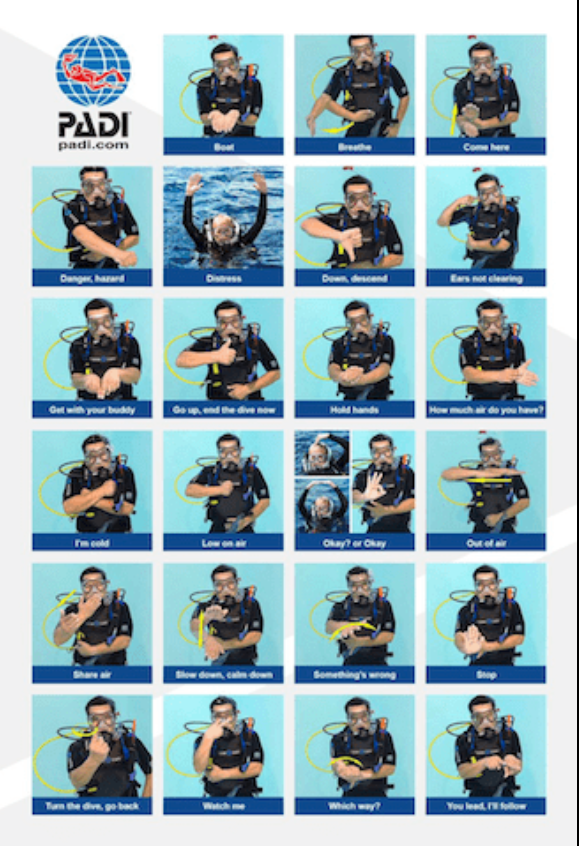
Diving Signals
Why Learn Marine Life Hand Signals?
If your buddy is grinning and pointing frantically into the blue, you probably already know there’s a bucket-list marine life encounter on the cards. However, knowing and recognizing the correct hand signals for different underwater creatures can still be pretty helpful during your dives. After all, a camouflaged stonefish or tiny nudibranch is much easier to spot once you know what creature your buddy is pointing out—and new divers will especially appreciate being taught which marine species they’re looking at (as well as what hazards to steer clear of!)
In addition to helping scuba divers communicate underwater, using hand signals for marine life while on the surface can also be a great way to teach kids about the ocean!
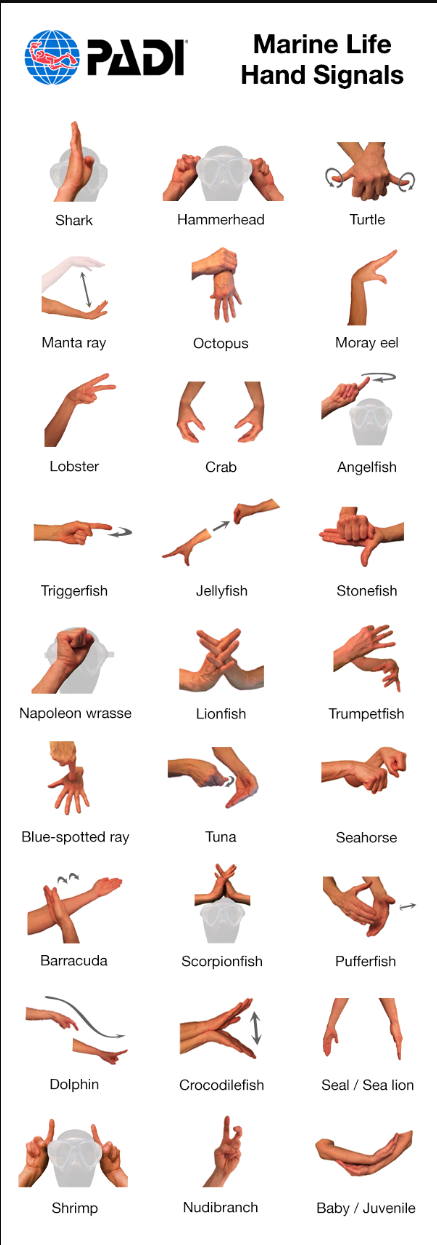
Marine Life Hand Signals
Mammals, Turtles, Sharks, and Rays
Shark: Hold the side of your hand against your forehead
Hammerhead: Place your fists on either side of your head
Manta ray: Flap both of your arms like you’re flying
Blue-spotted ray: Use your finger to tap random points on the back of your other hand
Dolphin: Ripple and move your index finger to mimic the way a dolphin swims
Seal / Sea lion: Make a clapping motion with both of your arms extended
Turtle: Place one hand on top of the other and rotate your thumbs
Crustaceans and Critters
Octopus: Wiggle your downturned fingers like they’re tentacles
Seahorse: Move both hands up and down like you’re riding a hobby horse
Moray eel: Tap the fingers and thumb of one hand together
Crab: The same as for moray eel, but do it with both hands turned sideways
Lobster: Do a scissor-like motion with your index and middle finger, on both hands
Shrimp: Point your index fingers upwards on either side of your forehead
Nudibranch: Create a “v” shape with your fingers and wiggle the ends
Jellyfish: Move your hand while opening and closing your fingers like tentacles
Other Fish
Stonefish: Make a fist and place it on the palm of your other hand
Napoleon wrasse: Hold your fist against your forehead
Lionfish: Interlock your fingers and wiggle them
Scorpionfish: Like lionfish, but put your hands on top of your head
Trumpetfish: Hold and move your fingers like you’re playing the trumpet
Tuna: Create a turning motion with one hand against the other, as if you’re opening a can
Barracuda: With one hand, do a chopping motion along your other arm
Angelfish: Draw a hoop (halo) shape above your head with your finger
Triggerfish: Point and bend your index finger, similar to pulling a trigger
Pufferfish: Clasp your hands and move them toward and away from each other
Crocodilefish: Put your palms together, then open and close them at the fingertips
And Finally…
Juvenile (baby): Add a cradling motion before the regular hand signal to indicate a juvenile
What is a briefing?
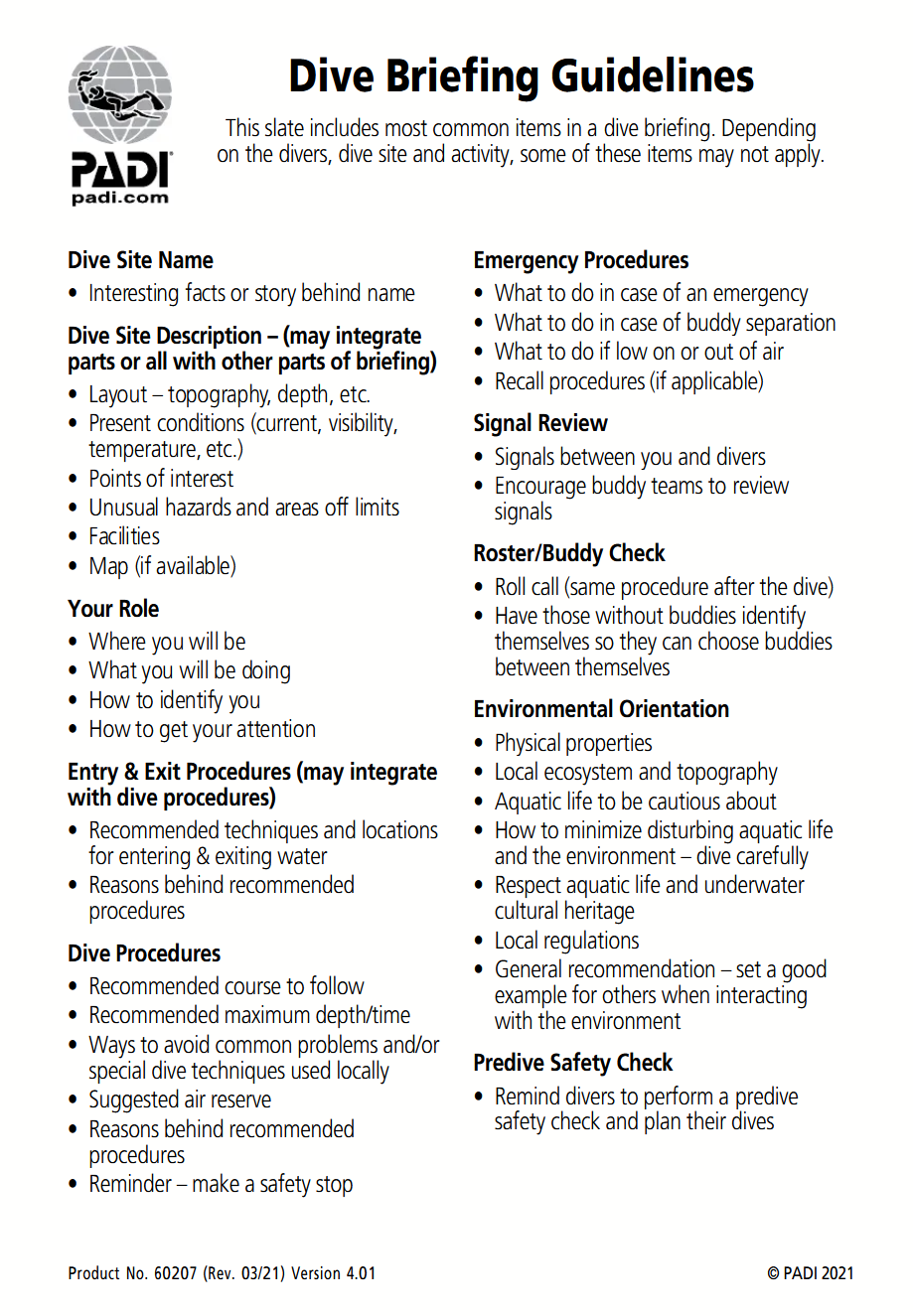
A briefing, in the world of diving, consists of a brief pre-dive explanation about the same or about the activity that is going to be carried out. Generally, following the PADI method, the following 10 points are covered:
Name of the dive site: at this point you can include some facts and anecdotes about the place.
Description of the dive site: includes the topography, depth, conditions (current, visibility, temperature), as well as points of interest or risk areas.
Role of the guide: it is important to know where you are going to be located, what you are going to be doing, how to identify it and how to capture its attention.
Entry and Exit Procedures: We need to clarify entry and exit techniques and points.
Dive Procedures: These include the course, max depth, air reserve, safety stop, and any special techniques we are going to use.
Emergency procedures: all divers must know what to do in an emergency (shortness of breath, losing a buddy…). In addition, a procedure must be established to call all divers if necessary.
Cue review: This way we make sure that the whole group remembers and uses the same cues.
Buddy Check: Make sure your gear is complete, both before and after the dive, and set up a buddy system.
PADI slates
Orientation about the environment: it is advisable to inform about the environmental characteristics of the dive site (flora and fauna) and remind divers that they must follow the rules of safe diving to minimize the disturbance of the environment.
Safety check: Remind divers to carry out a pre-dive safety check. To remember everything that we must review, we usually use the acronym CPTAO (Vest, Leads, Strips, Air, Okay)
How can it help me?
The main function of the briefing is to increase safety. This is achieved by giving us information prior to the dive that allows us to get an idea of what we are going to find underwater and what the methodology that we are going to follow is going to be.
Also, having protocols in place, especially in emergencies, decreases reaction time, which increases the chances of a successful outcome.
On the other hand, these pre-dive talks help us find points of interest during the dive and enjoy it more while being more relaxed. In addition, knowing more about the dive you are going to do makes it more interesting, since it allows us to see things that on other occasions we would have ignored and ensures that all divers know the route, allowing us to meet if necessary.
Divesite map
During the briefings you can also go over signs or any concerns that we have about diving.
When you begin your journey as a recreational scuba diver, you are likely to hear some words and phrases you do not know, and you might think the divers are speaking another language. Many words are scuba-specific, and there is a lot of scuba diving terminology that is useful to know if you want to become a scuba diver. We have made this cheat sheet for when you are unsure what the heck these scuba divers are talking about! Ready to get dive-lingual? Here is the scuba diving terminology you need to know.
When it comes to scuba diving terminology, knowing what your diving gear is called and how other divers may refer to each piece of kit is essential.
Here are the top diving equipment phrases to learn:
Equipment
1. BCD/BC/Jacket: You will get to know the buoyancy control device (BCD/BC/jacket) quite well during your Open Water Diver program. It is used to help you control and maintain good buoyancy while diving. You can add air into it, and release air from it to stay in the perfect position in the water.
2. Wing: A winged BCD is a type of jacket that only inflates at the back, rather than all around your body. These are most commonly used in technical diving.
3. Regs: Short for regulators, many divers shorten the word in diving conversations. The regulators are the set of hoses that attach your air tank to your BCD and your mouth for breathing.
4. Octopus/occy/alternate: The octopus is the alternate air source, after your main regulator that you keep in your mouth. You will always have a spare one, which is used in a sharing air situation.
5. First stage: This is the part of the regulators that connects to the tank. Depending on where you are in the world, you will use either a ‘DIN’ or a ‘yolk’ style first stage.
6. Inflator hose: This is usually located on the shoulder of the BCD and is connected to the tank. It has buttons which allow you to inflate or deflate the BCD.
7. Pressure gauge: A gauge to check how much air you have left in the tank. The answer is usually shown in PSI or BAR measurements, depending on where in the world you are diving.
8. Fins: NOT flippers! A common mistake with beginners, experienced divers will always use the word ‘fins’. If you do not know, diving fins are worn on your feet to help you move through the water easily.
Want to learn how to fin efficiently? Read this: From Novice to Pro: The 6 Best Finning Techniques for Divers
9. Mask: NOT goggles. Another common mistake, a diving mask differs from swimming goggles in that it also covers your nose.
10. Bottle/tank: The diving tank is attached to the BCD and is how you carry air along with you for your dive. The tank is sometimes referred to as a bottle. Tanks are usually made from either aluminium or steel.
11. Pony bottle: A pony bottle is a small tank of air that can be carried by the diver as an emergency supply. You will not see this so often in recreational diving, but pony bottles are sometimes used when deep diving or at remote destinations with strong currents.
12. O-ring: An O-ring is a small rubble circle that is used to make a seal in between parts. The connection part at the top of the tank will often have an O-ring, as well as parts of your regulators. You will hear this scuba diving terminology a lot on dive trips when people are doing multiple dives and need dive spares.
Want to dive like a pro? Here is: Scuba Diving Skills: Monthly Goals to Become a Better Diver
13. SMB/Sausage: A surface marker buoy (SMB) is an inflatable tube that signals to boats and other divers that you are below the surface. This can be inflated by air at depth via the regulator.
14. Rashy: Short for ‘rash vest’ which is used for many water sports to protect the torso from the sun, or make a wetsuit feel more comfortable.
15.Logbook: A book or online app such as MySSI where you keep track of your dives. You will include information about how deep the dive was, how long the dive was for (bottom time), as well as what marine life you saw.
16. Nitrox: Nitrox refers to when the gas in the tank is mixed differently to standard air (21% oxygen and 79% nitrogen). Nitrox has a slightly higher percentage of oxygen, which means divers can have a longer bottom time without needing to shallow up. You can become a nitrox diver by completing an enriched air nitrox certification. These certifications are very popular and allow divers to get the most out of every dive.
Diving procedures and safety
Your safety is paramount, and you will learn all about how to stay safe in the water during your scuba diving courses. To get you started, here is the scuba diving terminology you are likely to need:
17. Getting bent/DCS: DCS (decompression sickness) is a medical condition that might occur from surfacing too quickly or from staying too deep for too long. It is sometimes referred to as ‘getting bent’ because it can cause pain in the body’s joints and cause the diver to bend or hunch over in pain.
RELATED: The 6 Best Ways to Prevent Decompression Sickness
18. Bottom time: This is how long a diver will stay underwater. Knowing your bottom time can help you calculate how long or how deep your next dive should be.
19. Deco: You should not experience deco dives in most recreational diving. A deco dive is where the diver has gone beyond no-decompression limits, so they must make a longer/extra safety stop on their way to the surface because they stayed too deep for too long. In deep technical diving, this is planned for, but it is avoided in recreational diving.
20. Off-gassing: When we dive our bodies take on nitrogen. Nitrogen bubbles can form in the body’s tissues and cause DCS if our body does not ‘off-gas’ the extra nitrogen properly (due to a fast ascent or pushing diving limits).
21. Surface interval: We make a surface interval in between dives to give our bodies time to off-gas before the next dive. You will hear this scuba diving terminology on any day when you are doing more than one dive.
READ MORE: Top 9 Things To Do On A Surface Interval
22. Safety stop: We make a safety stop at the end of a recreational dive to off-gas the nitrogen, while still being at a shallow depth (this speeds up the process compared to being on the surface). A standard safety stop is done for three minutes at a depth of around 5 meters (16 feet).
23. No-fly time: The standard guidelines for flying after diving are to wait 12 hours after diving once, and to wait 18 hours after two or more dives. Some divers like to wait 24 hours just to be sure. Flying after diving can be dangerous as it raises the risk of DCS.
Diving skills
There are lots of different dive skills to learn and practice, whether you are a beginner scuba diver, an Advanced Open Water diver, or an experienced tec diver. Here is the scuba diving terminology you will need as you hone your skills.
24. Backroll: This is a way to enter the water from a small boat when you are boat diving. The diver will roll backwards into the water. You will hear this scuba diving terminology used during your dive briefings – when your SSI Dive Guide tells you what to expect from your upcoming dive.
25. Giant stride: This is another way to enter the water and is more commonly used from a boat or ledge. The diver strides forward from a standing position.
Want to know more? Here are: 3 ways scuba divers can enter the water from a boat
26. Buoyancy: This is your position in the water when you are diving. When you are ‘neutrally buoyant’ you are neither floating upwards (positively buoyant) nor sinking downwards (negatively buoyant). Your dive buoyancy can be controlled by using a mixture of your breath, the BCD, and a weight belt.
27. Hover: Hovering in the water is what you do when you are neutrally buoyant, and you are not kicking or sculling to move your body. Perhaps you are hovering to look at something interesting like the marine life in a rock crack or you are face to face with a beautiful manta ray.
28. Trim: This is your body’s position in the water and how streamlined you are. Having good trim means you will be horizontal in the water, with arms tucked in, and your hoses and gauges are also kept close to your body.
29. Dive buddy: Your dive buddy is who you will look out for during your dive, and who will look out for you. You should always be close to your buddy and check that they are okay regularly. One of the best things about scuba diving is the dive buddies and lifelong friends you make around the world. Check out our new Facebook community Underwater Explorers Worldwide to get inspired by our community of inclusive, passionate divers.
LEARN MORE: How to be the best dive buddy you can be
30. Equalize: When we dive, the pressure of going deeper will squeeze air spaces in the body. We have airspaces in the ears and sinuses, so a diver will usually hold their nose and blow to equalize the pressure. You should also add a little air from your nose to the mask if it starts to squeeze onto your face upon descent – this is also called equalizing. You learn how to equalize when you start scuba diving and it is an essential skill you will always need as a diver.
Extra scuba diving terminology
Okay, so you have mastered the essential scuba diving terminology, but there is always more to learn! Here are some bonus scuba diving phrases to help you blend in with more experienced divers and share your diving experiences:
31. Viz: The visibility of the water – or how far you can see ahead of you underwater and how clear the water is.
32. Narc’d/gas narcosis/nitrogen narcosis: This is a strange experience some divers have when they dive deep, usually past 35 meters (115 feet). The diver might feel sensations similar to being drunk. The symptoms usually go away simply by ascending a little bit.
33. Bait ball: A bait ball is a large school of fish that swarm together to protect themselves against predators. It is an incredible phenomenon to witness and attracts large pelagic marine life such as whales, sharks, sea lions and dolphins. You can go diving with bait balls during South Africa’s sardine run, at Magdalena Bay in Baja California, and at Moalboal in the Philippines.
34. Thermocline: A thermocline refers to when the temperature of the water suddenly drops. Some deep dive spots have dramatic thermoclines where the water suddenly becomes very cold!
35. Liveaboard: A trip that divers can go on, where they live on the boat for a few days and make multiple dives at various dive sites. Liveaboard diving is very popular and allows divers to reach some of the world’s best (and most remote) dive destinations, like the Socorro Islands, the Galapagos Islands and the beautiful islands that diving in Palau is famous for.
Now you know your scuba diving terminology, we hope you are inspired to start diving!
More Questions? We’ve got you Covered!
Frequently Asked Questions
Certification
- How long does it take to complete a course?
- Do I need to prepay for a course or fun dive?
- How much time do I need to dedicate to eLearning?
- Does my course expire?
- Do I need to know how to swim?
- Do I need medical clearance to dive?
- Can I Fly after diving?
- When do I need to take a refresher (ReActivate) session after a period of activity?
- What should I bring when I come diving?
- How long will it take for my certification to be processed?
- Can I scuba dive without certification?
- How deep can I go with my PADI certification or experience?
- Can I dive with a PADI certification anywhere in the world?
- Does PADI certification expire?
- Will I receive a plastic certification card?
- Continue Education
Explore More
- How long does it take to complete a course?
- Do I need to prepay for a course or fun dive?
- How much time do I need to dedicate to eLearning?
- Does my course expire?
- Do I need to know how to swim?
- Do I need medical clearance to dive?
- Can I Fly after diving?
- When do I need to take a refresher (ReActivate) session after a period of activity?
- What should I bring when I come diving?
- How long will it take for my certification to be processed?
- Can I scuba dive without certification?
- How deep can I go with my PADI certification or experience?
- Can I dive with a PADI certification anywhere in the world?
- Does PADI certification expire?
- Will I receive a plastic certification card?
- Continue Education
General Queries
- Operating Hours
- Contact Us
- Payment Method
- Servicing Diving Gear?
- Do You Sell diving gear?
- Cancellation Policy
- Why is Khorfakkan Famous?
- Which Ocean does khorfakkan look at?
- Is khorfakkan good for Scuba Diving?
- Things to pack for diving
Explore More
- Operating Hours
- Contact Us
- Payment Method
- Servicing Diving Gear?
- Do You Sell diving gear?
- Cancellation Policy
- Why is Khorfakkan Famous?
- Which Ocean does khorfakkan look at?
- Is khorfakkan good for Scuba Diving?
- Things to pack for diving
Nitrox eRDPml
- eRDP
- Nitrox eRDPml
Explore More
- eRDP
- Nitrox eRDPml
Think Like a Diver
- The Proper Dive Buddy Check – How Do You Say BWRAF?
- Rules Every Diver Should Follow
- Top 10 Scuba Diving Rules
- 10 Things You Should Never Do Immediately After Diving
- Most Important Scuba Diving Abbreviations & Acronyms
- Diving Signals
- Marine Life Hand Signals
- Dive Briefing
- Boat Diving Guidelines
Explore More
- The Proper Dive Buddy Check – How Do You Say BWRAF?
- Rules Every Diver Should Follow
- Top 10 Scuba Diving Rules
- 10 Things You Should Never Do Immediately After Diving
- Most Important Scuba Diving Abbreviations & Acronyms
- Diving Signals
- Marine Life Hand Signals
- Dive Briefing
- Boat Diving Guidelines
PADI Theory - Physics
- Physics
Explore More
- Physics
PADI Theory - Physiology
- Physiology
Explore More
- Physiology
PADI Theory - Equipment
- Cylinders
- Cylinder Valve
- More Equipment
Explore More
- Cylinders
- Cylinder Valve
- More Equipment
PADI Theory - Dive Skills
- Buoyancy – Proper Weighting Skills
Explore More
- Buoyancy – Proper Weighting Skills
PADI Theory - Environment
- 10 Tips to Save the Ocean
- What is Dive Against Debris?
Explore More
- 10 Tips to Save the Ocean
- What is Dive Against Debris?
Emergency First Response
- What is Emergency First Response (EFR) ?
- Who can take an Emergency First Response provider course?
- What is an AED and why would I want to learn about it?
- How often must I refresh my skills?
- What the Emergency First Response Course Covers?
Explore More
- What is Emergency First Response (EFR) ?
- Who can take an Emergency First Response provider course?
- What is an AED and why would I want to learn about it?
- How often must I refresh my skills?
- What the Emergency First Response Course Covers?
Rescue
- What Is the PADI Rescue Diver Course?
- What Does a Rescue Diver Actually Do?
- How Hard Is It To Become a Rescue Diver?
- What Prerequisites Do I Need To Take Part in a PADI Rescue Diver Course?
- How Many Dives Does It Take To Become a Rescue Diver?
- What Skills Do You Learn During the Rescue Diver Course?
- Why Do I Need First Aid Training To Do the Rescue Diver Course?
- Do I Really Need To Become a Rescue Diver? Is It Worth Taking the Course?
Explore More
- What Is the PADI Rescue Diver Course?
- What Does a Rescue Diver Actually Do?
- How Hard Is It To Become a Rescue Diver?
- What Prerequisites Do I Need To Take Part in a PADI Rescue Diver Course?
- How Many Dives Does It Take To Become a Rescue Diver?
- What Skills Do You Learn During the Rescue Diver Course?
- Why Do I Need First Aid Training To Do the Rescue Diver Course?
- Do I Really Need To Become a Rescue Diver? Is It Worth Taking the Course?
DAN Insurance
- Long term Dan Insurance Plan
- Short Term Dan Insurance Plan
Explore More
- Long term Dan Insurance Plan
- Short Term Dan Insurance Plan