Divers FAQ's
Environment
Got Questions?
Understanding the Diving Environment: Waves, Tides, & Marine Life
Environment
Your Pre-Dive Safety Check:
Weather Forecast
Click here for weather conditions.
In the world of scuba diving, the environment and weather forecast aren’t just conversation starters—they are the ultimate deciders of your underwater experience. Wind speed and direction directly dictate surface conditions and swell, often determining whether a shore entry is safe or a boat ride will be ‘choppy.’ Beyond the surface, the tidal cycle plays a pivotal role; diving during slack tide can mean the difference between a calm, effortless hover and fighting a localized current. Furthermore, heavy rainfall can lead to coastal runoff, which significantly impacts underwater visibility. By monitoring reliable marine forecasts and understanding how environmental shifts affect water temperature and surge, divers can ensure they have the right thermal protection and equipment for a safe, high-visibility adventure.”
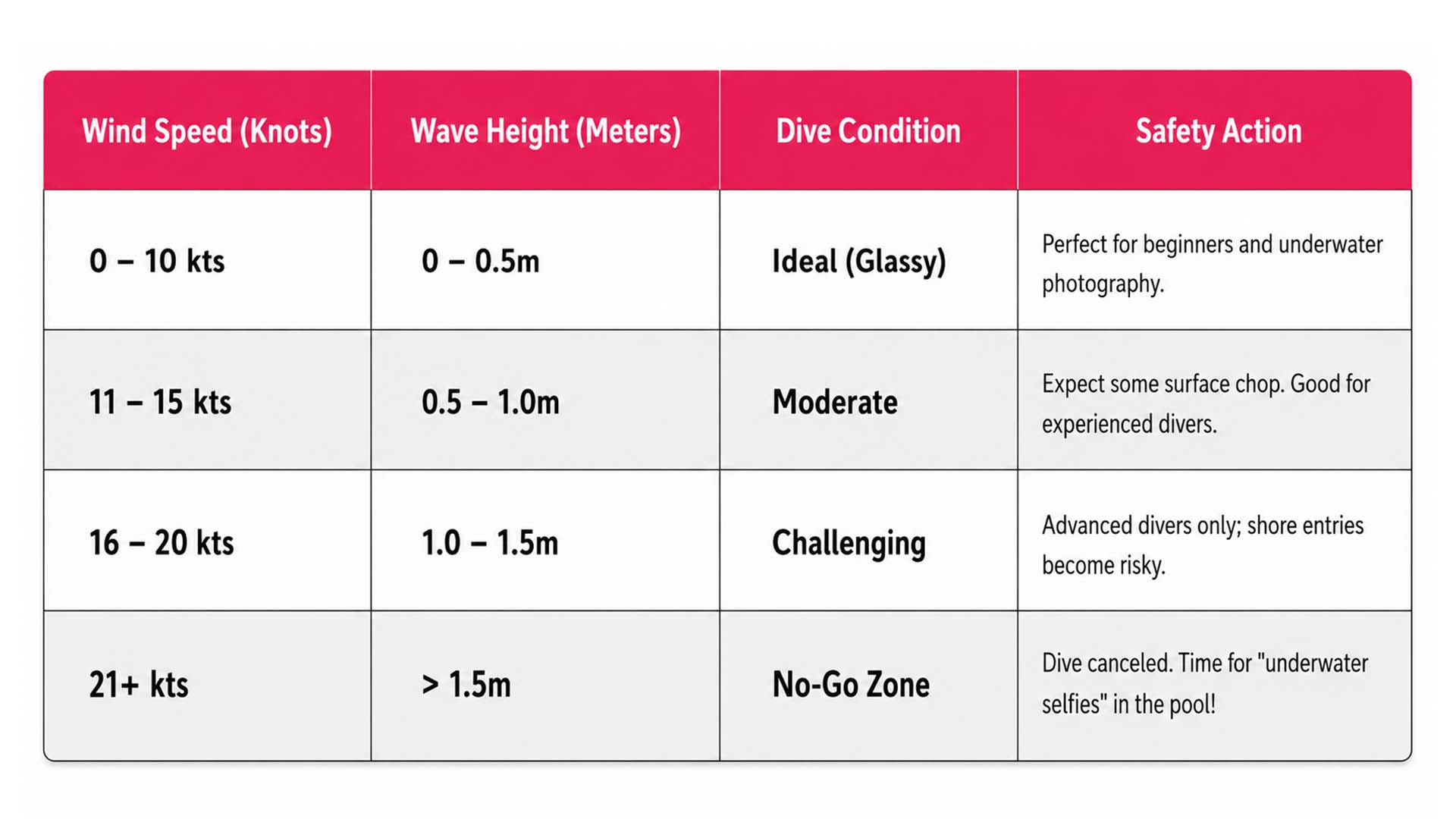
PADI Dive Theory: Master the Environment & Diving Conditions
Weather Forecast
Click here for weather conditions.
Water Movement: Tides, Currents, and Diver Safety
To master the PADI Environment topic, you need to understand how the moon and the earth’s topography dictate your dive plan.
1. Tides: The Vertical Shift
Tides are the rise and fall of sea levels caused by the gravitational pull of the moon and sun.
The “Slack” Window: The best time to dive is often during Slack Tide (the brief period between high and low tide when the water stops moving). This offers the best visibility and the least resistance.
The SEO Angle: Mentioning “Slack Tide” and “Tidal Ranges” helps you rank for technical diving queries.
2. Currents: The Horizontal Flow
Currents move water from one place to another. In your PADI theory, we focus on two main types:
Permanent Currents: Driven by global factors like temperature and Earth’s rotation (e.g., the Gulf Stream).
Transitory Currents: These are local and temporary, like Rip Currents (caused by waves breaking on shore) or Longshore Currents (moving parallel to the beach).
PADI Pro-Tip for the Exam:
Remember the Rule: Always start your dive into the current. This ensures that when you are tired at the end of the dive, the current will help carry you back to the boat or shore.
Sustainable Scuba DIving
Weather Forecast
Click here for weather conditions.
In PADI Dive Theory, the environment section emphasizes that we are guests in the underwater world. Understanding how to interact with marine life safely is just as important as knowing your gas laws.
1. The Golden Rule: Passive Interaction
The PADI philosophy is “Look but don’t touch.” Passive interaction protects the delicate mucous coating on fish and prevents damage to fragile coral polyps.
2. Potential Hazards: Defensive, Not Offensive
Most “dangerous” marine life encounters are defensive. We categorize hazards into three types:
Stinging/Abrasive: Like fire coral or jellyfish.
Venomous: Like lionfish or stonefish (usually hidden in the substrate).
Biting: Usually occur only if an animal is provoked or feels cornered (like a Moray Eel).
3. Conservation & The “Diver’s Impact”
As a diver, your biggest environmental impact is your buoyancy. Poor buoyancy leads to “silting” (covering coral in sand) or direct physical damage to the reef.
To care for the marine life, enhance your “Peak Performance Buoyancy” specialty course page to drive internal traffic and conversions.
PADI Pro-Tip for the Exam:
Question: What is the primary cause of most aquatic life injuries? Answer: Human carelessness. Most injuries result from the diver accidentally touching an animal or trying to handle it. Always maintain good situational awareness!
Top 7 Marine Life Species You’ll See in UAE:
- Turtle
- Clownfish
- Stone Fish
- Nudibranchs
- Moray Eel
- Crabs
- Boxer Shrimps
In the diving industry, “Safety” and “Conservation” are the two biggest pillars of your brand authority. When writing these tips for your website or social media, you want to sound like a seasoned professional who respects the ocean’s boundaries.
Here are 5 expert tips for safe marine life observation, optimized for divers:
1. Master the Art of “Passive Interaction”
The #1 rule in the PADI curriculum is to be a silent observer. Never touch, poke, or chase marine life. Touching fish can rub off their protective slime coat, leaving them vulnerable to infections, while chasing animals causes them unnecessary stress and oxygen depletion.
2. Maintain “Neutral Buoyancy”
Safe observation starts with your skills. If you are struggling to stay still, you are likely to crash into the reef or kick up silt, which scares away the animals and damages coral. Use your breath to hover at a respectful distance (at least 2–3 meters).
3. Avoid “Cornering” or Blocking Exits
Always give marine life an “out.” If you see an eel in a crevice or an octopus in a hole, don’t surround them with a group of divers. When an animal feels trapped, it is much more likely to exhibit defensive behavior (biting or striking). Always leave a clear path for the animal to swim away.
4. Watch for Behavioral Cues
Animals usually tell you when they are uncomfortable. Look for “warning” signs: a pufferfish inflating, a moray eel gaping its mouth wide, or a shark “hunching” its pectoral fins. If the animal changes its behavior because of you, you are too close. Back away slowly.
5. Be Mindful of the Bottom (The “Invisible” Life)
Safe observation isn’t just about what’s in front of you—it’s about what’s below you. Many venomous or fragile species, like stonefish, scorpionfish, or nudibranchs, live on the seafloor or tucked into the reef. Always look before you settle or use a finger to steady yourself (which you should avoid anyway!).
“By following these safe marine life observation tips, you aren’t just protecting the ocean; you’re ensuring better encounters. Calm, respectful divers are rewarded with longer, more intimate sightings of the reef’s most incredible residents.”
Sustainable Scuba DIving
Weather Forecast
Click here for weather conditions.
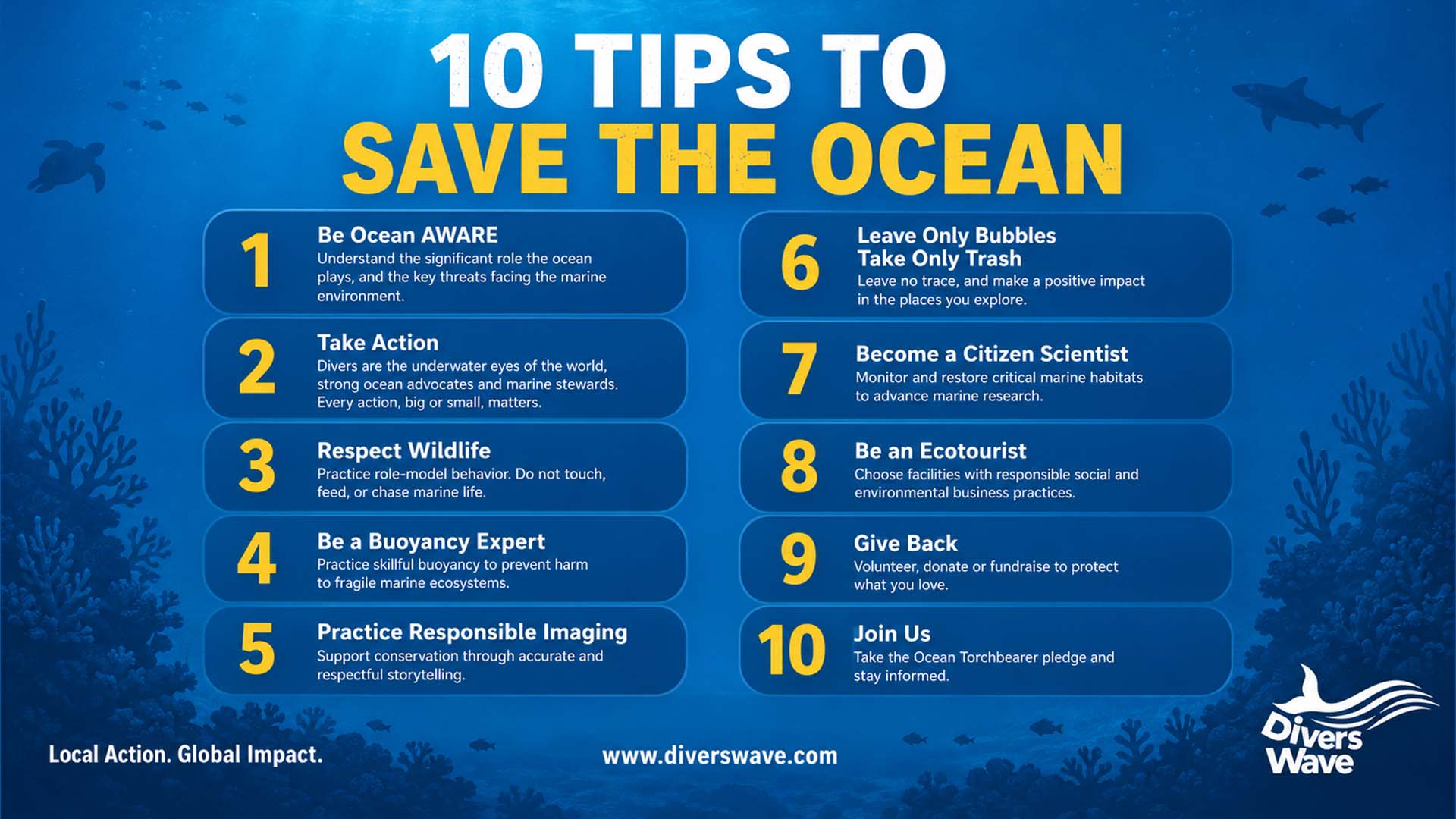
If you want to learn about ocean conservation and how you can contribute to saving the ocean, the updated PADI AWARE Specialty course is perfect for you. This course focuses on 10 tips to save the ocean, giving you the tools to make a difference for the beautiful ocean every time you dive, travel, or go about your daily life. Now supported by eLearning, this course and tips are easier than ever to access – you can complete the academic portion of the course at your own pace, using your desktop, laptop, or mobile device. Here’s a sneak preview of the course’s all-new 10 tips to save the ocean!
1. Be Ocean AWARE
Tip number one teaches the significant role the ocean plays, the key threats facing the marine environment and the value of current conservation initiatives. Knowledge and understanding is the foundation of ocean conservation!
2. Take Action
Divers are the underwater eyes of the world, strong ocean advocates and marine stewards. For example, divers can fight against marine debris all over the world by collecting and reporting data on the trash they collect on dives. This information contributes to a global science database and environmental policy that can be used to protect the ocean. Every action, big or small, matters.
3. Respect Wildlife
Marine life, like manta rays and sharks, are major dive attractions. Many divers and snorkelers want to see the amazing marine life, making it especially important to practice role-model behavior to minimize stress and to keep the marine life safe and healthy. Best practices around wildlife are to not feed, touch or chase marine life.
4. Be a Buoyancy Expert
Beautiful coral reefs are popular dive sites and important marine ecosystems. Unfortunately, diving in these ocean ecosystems comes with a risk of hitting, brushing against or resting on the coral and thereby harming it! This is why practicing skillful buoyancy to prevent harm to coral reefs and other fragile marine ecosystems is super important.
5. Practice Responsible Imaging
There’s a reason we have the saying, “A picture can say a thousand words.” Photography can be a powerful tool for ocean conservation, but these beautiful pictures should be taken a responsible and respectful manner. Tip number five teaches how to support conservation through accurate and respectful storytelling.
6. Leave Only Bubbles, Take Only Selfies…
You are a guest when you dive in the ocean, so it’s best to not disturb the dive site as you could be harming the homes of marine life! Another best practice is to leave the site as clean or even cleaner than when you first dove in. Leave no trace, and make a positive impact in the places you explore.
7. Become a Citizen Scientist
Tip number seven dives deeper into the realm of actions you can take above and below the waves to directly contribute to science programs and tangible actions as a citizen scientist. Science and conservation are collective efforts, and you can contribute!
8. Be an Ecotourist
Tip number eight teaches students how to travel responsibly, minimize your environmental impact and identify sustainable dive centers and tour operators. Dive centers can play big roles putting the tips to save the ocean into action. For this purpose, Green Fins can help you find dive shops and other operators with responsible social and environmental business practices.
9. Give Back
You can volunteer, donate or fundraise to protect what you love. To get started, check out your local PADI dive center to see if they are hosting volunteer events, like beach cleanups.
10. Join Us
All of the tips encompass the essence of what it means to be an Ocean Torchbearer! Join our community of ocean advocates around the world to help drive action at the local level for global ocean conservation.
What ihe heart of PADI AWARE Foundation™ marine debris program since 2011, Dive Against Debris® has advanced groundbreaking marine research, producing two scientific publications mapping the global state of marine debris. Join the largest movement for marine debris on the planet. Grab your mesh bag and data slate – and make #EveryDiveaSurveyDive!
Introducing the PADI AWARE Conservation Action Portal (CAP)
The PADI AWARE Conservation Action Portal (CAP) is the central hub for logging conservation actions like Dive Against Debris® surveys and Adopt the Blue activities. Through the PADI AWARE Conservation Impact Map, you can showcase your dive center’s leadership and amplify your conservation efforts globally.
CAP is accessible via your PADI SSO and offers a seamless web and mobile app experience—making it easy to turn every action into visible, trackable impact for ocean conservation.
What is Dive Against Debris?
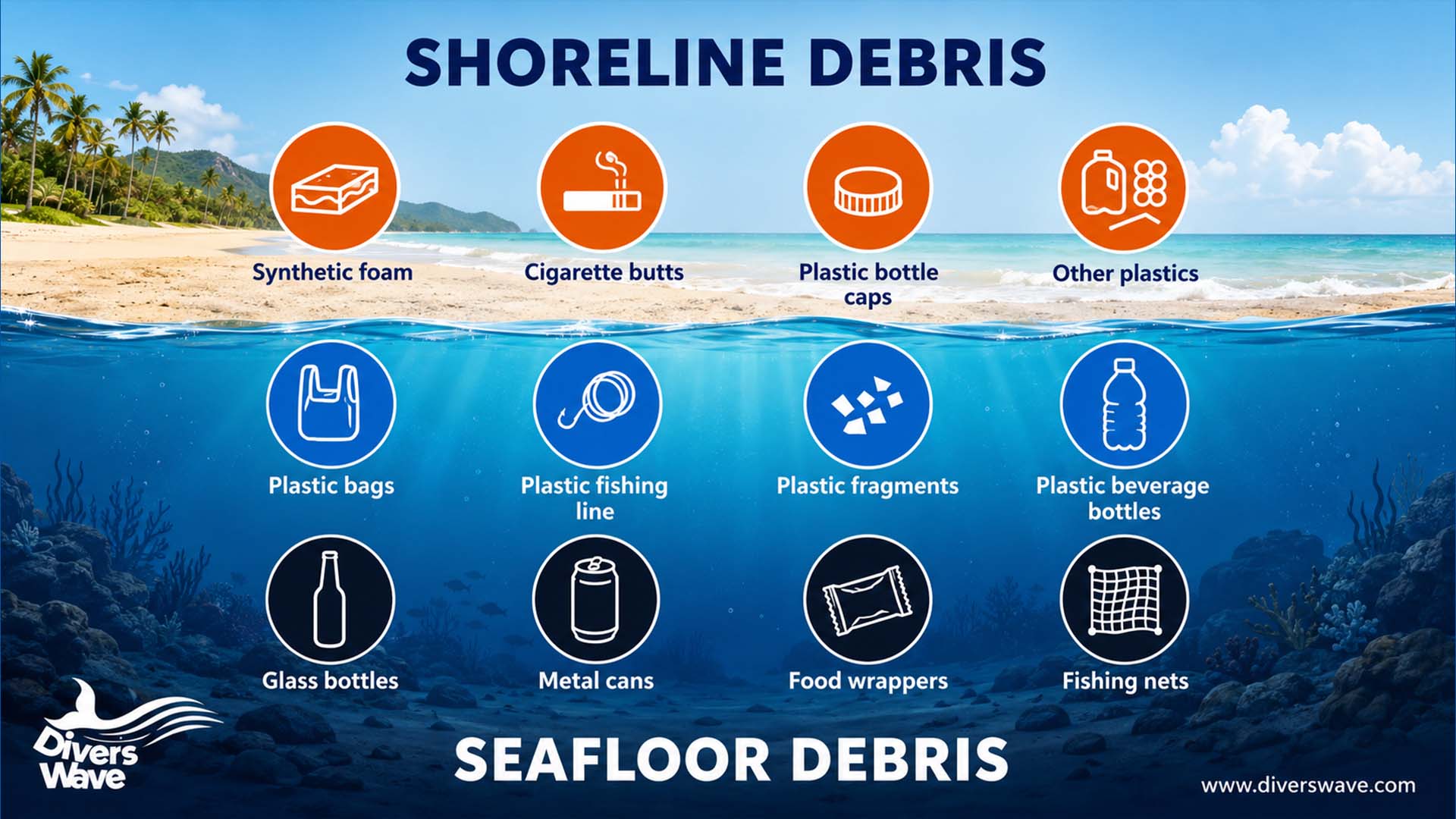
Dive Against Debris® is PADI AWARE Foundation’s flagship citizen-science program, empowering scuba divers to remove marine debris from underwater (both in fresh and salt water), to report data on the types, quantities, and locations of rubbish collected.
As the only underwater debris data collection program of its kind, Dive Against Debris both improves the health of ocean ecosystems through local action and provides valuable information about underwater debris to help inform policy change for global impact.
What issue is it tackling?
It is thought that ~70% of all debris and ~94% of plastics entering the ocean sink to the seafloor. However, there have been gaps in this data regarding seafloor marine debris – a gap that scuba divers are perfectly positioned to fill! See PADI AWARE’s Marine Debris page for more information.
Why is it important?
Since the program’s launch, more than 100,000 divers have participated in Dive Against Debris in 120 countries around the world, reporting more than 2,000,000 million pieces of trash – highlighting geographical distribution, hotspots, changes that have occurred over time, and marine animal entanglement.
How can I become a Dive Against Debris Diver?
Take the PADI AWARE Dive Against Debris Specialty course, now with PADI eLearning!
Any PADI Junior Open Water Diver, Freediver, Advanced Mermaid or higher can take the Dive Against Debris Specialty course and help tackle marine debris issues head-on.
Once reported, your Dive Against Debris data enters a global database to help support the development and implementation of policies to improve solid waste management, locally and globally.
The PADI AWARE App and Conservation Action Portal
Download the free PADI AWARE App to access the Conservation Action Portal from Google Play or the Apple App Store and turn your phone into a tool for conservation. Join PADI AWARE Foundation volunteers around the globe who are taking action to rid marine environments of marine debris, and work together to save marine wildlife. Making change is as easy as logging your dives.
How does Dive Against Debris support marine research?
In collaboration with Ocean Conservancy (largest global dataset of beach debris) and CSIRO (Commonwealth of Scientific and Industrial Research Organization – world leaders in marine debris research), we devised the first quantitative analysis of global marine debris from land and sea sources: A global assessment of the relationship between anthropogenic debris on land and the seafloor.
Want to support continued efforts?
Make a Donation to PADI AWARE Foundation
More Questions? We’ve got you Covered!
Frequently Asked Questions
Certification
- How long does it take to complete a course?
- Do I need to prepay for a course or fun dive?
- How much time do I need to dedicate to eLearning?
- Does my course expire?
- Do I need to know how to swim?
- Do I need medical clearance to dive?
- Can I Fly after diving?
- When do I need to take a refresher (ReActivate) session after a period of activity?
- What should I bring when I come diving?
- How long will it take for my certification to be processed?
- Can I scuba dive without certification?
- How deep can I go with my PADI certification or experience?
- Can I dive with a PADI certification anywhere in the world?
- Does PADI certification expire?
- Will I receive a plastic certification card?
- Continue Education
Explore More
- How long does it take to complete a course?
- Do I need to prepay for a course or fun dive?
- How much time do I need to dedicate to eLearning?
- Does my course expire?
- Do I need to know how to swim?
- Do I need medical clearance to dive?
- Can I Fly after diving?
- When do I need to take a refresher (ReActivate) session after a period of activity?
- What should I bring when I come diving?
- How long will it take for my certification to be processed?
- Can I scuba dive without certification?
- How deep can I go with my PADI certification or experience?
- Can I dive with a PADI certification anywhere in the world?
- Does PADI certification expire?
- Will I receive a plastic certification card?
- Continue Education
General Queries
- Operating Hours
- Contact Us
- Payment Method
- Servicing Diving Gear?
- Do You Sell diving gear?
- Cancellation Policy
- Why is Khorfakkan Famous?
- Which Ocean does khorfakkan look at?
- Is khorfakkan good for Scuba Diving?
- Things to pack for diving
Explore More
- Operating Hours
- Contact Us
- Payment Method
- Servicing Diving Gear?
- Do You Sell diving gear?
- Cancellation Policy
- Why is Khorfakkan Famous?
- Which Ocean does khorfakkan look at?
- Is khorfakkan good for Scuba Diving?
- Things to pack for diving
Nitrox eRDPml
- eRDP
- Nitrox eRDPml
Explore More
- eRDP
- Nitrox eRDPml
Think Like a Diver
- The Proper Dive Buddy Check – How Do You Say BWRAF?
- Rules Every Diver Should Follow
- Top 10 Scuba Diving Rules
- 10 Things You Should Never Do Immediately After Diving
- Most Important Scuba Diving Abbreviations & Acronyms
- Diving Signals
- Marine Life Hand Signals
- Dive Briefing
- Boat Diving Guidelines
Explore More
- The Proper Dive Buddy Check – How Do You Say BWRAF?
- Rules Every Diver Should Follow
- Top 10 Scuba Diving Rules
- 10 Things You Should Never Do Immediately After Diving
- Most Important Scuba Diving Abbreviations & Acronyms
- Diving Signals
- Marine Life Hand Signals
- Dive Briefing
- Boat Diving Guidelines
PADI Theory - Physics
- Physics
Explore More
- Physics
PADI Theory - Physiology
- Physiology
Explore More
- Physiology
PADI Theory - Equipment
- Cylinders
- Cylinder Valve
- More Equipment
Explore More
- Cylinders
- Cylinder Valve
- More Equipment
PADI Theory - Dive Skills
- Buoyancy – Proper Weighting Skills
Explore More
- Buoyancy – Proper Weighting Skills
PADI Theory - Environment
- 10 Tips to Save the Ocean
- What is Dive Against Debris?
Explore More
- 10 Tips to Save the Ocean
- What is Dive Against Debris?
Emergency First Response
- What is Emergency First Response (EFR) ?
- Who can take an Emergency First Response provider course?
- What is an AED and why would I want to learn about it?
- How often must I refresh my skills?
- What the Emergency First Response Course Covers?
Explore More
- What is Emergency First Response (EFR) ?
- Who can take an Emergency First Response provider course?
- What is an AED and why would I want to learn about it?
- How often must I refresh my skills?
- What the Emergency First Response Course Covers?
Rescue
- What Is the PADI Rescue Diver Course?
- What Does a Rescue Diver Actually Do?
- How Hard Is It To Become a Rescue Diver?
- What Prerequisites Do I Need To Take Part in a PADI Rescue Diver Course?
- How Many Dives Does It Take To Become a Rescue Diver?
- What Skills Do You Learn During the Rescue Diver Course?
- Why Do I Need First Aid Training To Do the Rescue Diver Course?
- Do I Really Need To Become a Rescue Diver? Is It Worth Taking the Course?
Explore More
- What Is the PADI Rescue Diver Course?
- What Does a Rescue Diver Actually Do?
- How Hard Is It To Become a Rescue Diver?
- What Prerequisites Do I Need To Take Part in a PADI Rescue Diver Course?
- How Many Dives Does It Take To Become a Rescue Diver?
- What Skills Do You Learn During the Rescue Diver Course?
- Why Do I Need First Aid Training To Do the Rescue Diver Course?
- Do I Really Need To Become a Rescue Diver? Is It Worth Taking the Course?
DAN Insurance
- Long term Dan Insurance Plan
- Short Term Dan Insurance Plan
Explore More
- Long term Dan Insurance Plan
- Short Term Dan Insurance Plan